Managed on-site service
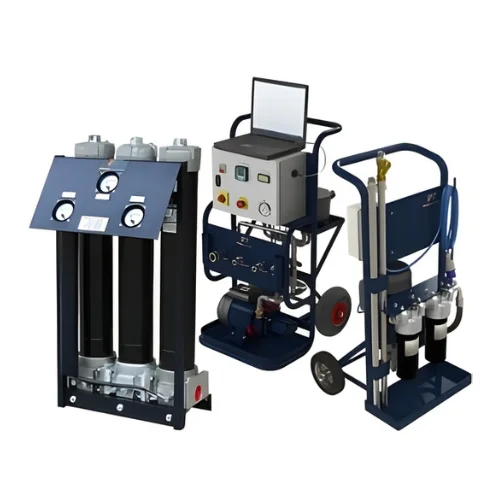
A temporary external loop suits a defined cleanup, oil change, commissioning task or contamination event. NATCOM supplies the equipment, field scope and before-and-after checks.

NATCOM removes particles and water from turbine oil with a purification plan matched to the machine, then verifies the result. Choose a managed on-site service or permanent equipment across Egypt and Saudi Arabia.
Turbine lube-oil care
Turbine oil purification is the turbine-specific branch of NATCOM's industrial oil filtration service. A separate treatment loop, often called offline filtration, draws oil from the reservoir through particle filters and, when needed, water-removal equipment before returning it to the system. The starting sample decides what that loop needs to do. Particle count, water condition, oil chemistry and the turbine requirement are separate questions. Filtration can recover suitable oil from contamination, but it cannot reverse every form of oil degradation. NATCOM sets the target before treatment and checks the same measurements when the work is done.
These signs justify sampling. They do not prove that filtration is the complete answer.
A high or rising ISO 4406 code can point to dirt ingress, wear debris, transfer contamination or filtration that is not controlling the system.
Free water, haze or a high measured water level calls for the source, amount and form of water to be established before treatment.
Short filter life may reflect continuing ingress, material already held in the system or a filter arrangement that does not match the duty.
Particles and water may contribute to control or bearing problems, but oil results and machine evidence must be read together.
How NATCOM handles it
The plan starts with the system and a representative sample. The same evidence confirms what changed after treatment. For water-contaminated turbine or compressor oil, distinguish the water-removal methods and define the moisture checks before treatment.
Record the oil type, reservoir volume, viscosity, temperature, flow, filter arrangement, connection points and turbine requirements.
Take a representative sample for particle cleanliness and water. Add oil-health tests when oxidation, additive condition or deposits are in question.
Match flow, filter media and water-removal method to the fluid, then circulate through a separate treatment loop where the system allows it.
Sample again from the agreed point, compare the same measurements and document the result against the target set before treatment.
Matched to the system
Reservoir volume, contamination, required turnaround and the need for ongoing control determine whether the right answer is a field service or equipment that stays with the turbine.
A temporary external loop suits a defined cleanup, oil change, commissioning task or contamination event. NATCOM supplies the equipment, field scope and before-and-after checks.
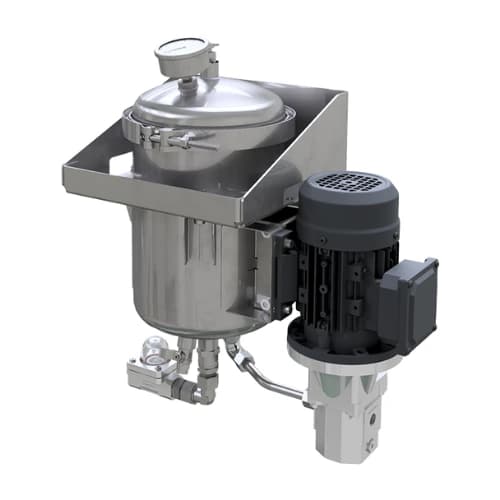
A fixed unit that circulates oil through a separate loop can suit systems that need recurring contamination control. The exact unit, flow, media and service plan are selected only after the oil and system requirements are checked.
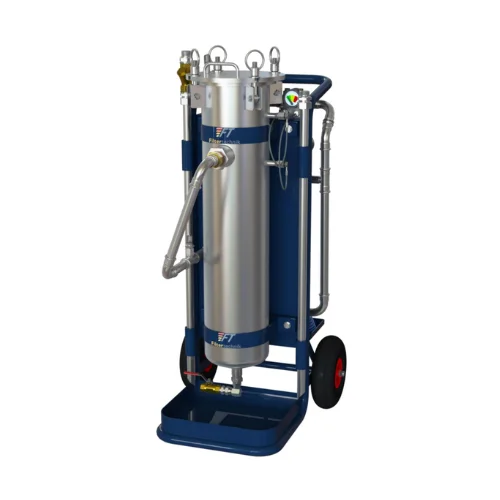
When water is the main problem, a compatible dehydration or separation method can be added to particle control. The starting water condition sets the treatment plan.
Permanent equipment
NATCOM scopes portable or fixed equipment together with the sampling and service plan for the site.
Published Neptune range
These figures come from Filtertechnik's published Neptune specifications. NATCOM confirms fluid and system compatibility, then selects the unit from the oil type, volume, starting water level and treatment target.
Choose the operating model
Both routes can use an offline treatment loop. The difference is who operates it, how long it stays connected and whether the contamination risk is temporary or recurring.
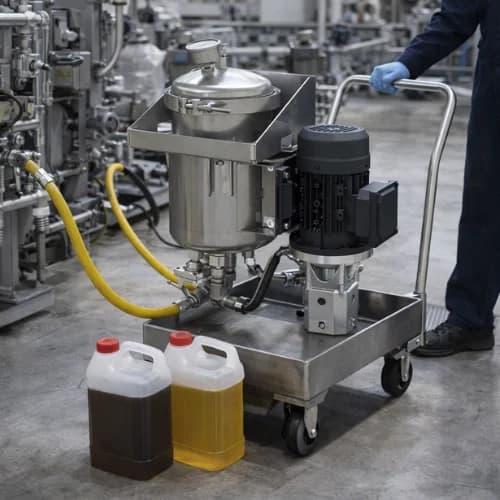
Use a managed service for a known contamination event, reservoir cleanup, oil transfer, commissioning step or planned outage, or when the site needs specialist equipment and operators for a set period rather than another installed asset. NATCOM supplies the field setup, monitors filter loading and treatment progress, and records the agreed final measurements.
Install a fixed system when contamination enters repeatedly, the turbine has a continuing cleanliness requirement or the risk justifies scheduled or continuous treatment through a separate loop. Design it with safe connections, flow, filter indication, water handling and sampling points, and make sure the plant can inspect and service it.
Know the limit
A similar symptom can come from particles, water, oil degradation or deposits. Testing keeps the filtration scope tied to the problem it can solve. Valve response, filter behaviour and oil results help determine whether a separate varnish assessment is needed.
Use particle filtration
Set the target from the turbine requirement and the measured ISO 4406 cleanliness code.
Select water-removal equipment
Confirm the water level, oil compatibility, temperature and required result before treatment.
Test before deciding
Oxidation, viscosity change or depleted additives may call for another treatment or an oil change.
Use a varnish-specific plan
Conventional particle filtration does not necessarily remove soluble varnish or deposits inside the system.
Related rotating equipment
Critical compressors also depend on controlled lube-oil cleanliness and water levels. The same measure, treat and verify method applies, but the compressor train has to be mapped first. A shared train can contain separate lubrication, seal and control-oil circuits with different fluids and requirements. NATCOM scopes each circuit against its reservoir, operating temperature, access points, filter arrangement and machine requirements. That prevents one sample or one filtration unit from being assumed suitable for the whole train. When testing shows varnish rather than a particle or water problem, the compressor oil needs the same separate varnish assessment used for turbine systems.
A compressor train may have dedicated lube, seal or control-oil circuits. Each reservoir, fluid and sample point needs its own treatment basis.
Particle and water targets should follow the compressor and oil-system requirements, with machine symptoms checked alongside the sample results.
A managed cleanup can address a defined event. A fixed offline system is better when the circuit needs scheduled or continuous control.
Local teams
From its Cairo and Al Khobar offices, NATCOM plans each job around the turbine, the oil condition and the site's operating constraints.
Cairo office
NATCOM scopes turbine oil sampling, particle filtration and water-removal work across Egypt. There, NATCOM is ExxonMobil Egypt's sole service partner for services including oil sampling, solid-particle filtration and water removal.
Al Khobar office
From Al Khobar, NATCOM scopes Saudi turbine and compressor oil-filtration projects for power, oil and gas, petrochemical and industrial sites. The system, target and access decide the equipment and field plan.
Turbine oil filtration circulates oil through selected media to remove solid particles. A broader purification setup can also include water-removal equipment. The oil, contamination and turbine requirement determine the equipment and target.
Filtration usually means particle removal. Purification is the wider treatment, which may combine particle filtration with water removal and monitoring. Neither term means that degraded oil chemistry has been restored.
Some systems can use an external offline loop while the turbine operates. NATCOM confirms safe connection points, oil temperature, flow, filtration, site rules and equipment-manufacturer requirements before proposing that arrangement.
A managed service usually suits a one-time cleanup, oil change, commissioning task or known contamination event. Permanent equipment suits critical systems with recurring ingress or a continuing cleanliness requirement. The plant also needs the people and maintenance plan to operate a fixed system.
Yes, when the system includes a water-removal method suited to the oil and the form of water present. Free, entrained and dissolved water do not all respond to the same equipment, so the starting condition must be measured first.
NATCOM agrees the particle and water targets before treatment, samples from a defined point, and compares the same measurements after treatment. Oil-health tests are added when the question goes beyond contamination.
Not necessarily. Particle filters can capture some suspended material, but soluble varnish and deposits on internal surfaces need varnish-specific testing and treatment. NATCOM separates the contamination problem from the varnish problem before scoping the work.
Yes, after the compressor oil circuit, fluid, reservoir, contamination and equipment requirements are confirmed. Compressor trains may have several oil systems, so each circuit must be assessed rather than treated as one shared volume.
Yes. NATCOM scopes turbine oil sampling, filtration, water removal and purification projects through its teams in Cairo and Al Khobar. Each job is configured for the turbine, oil, target and site conditions.
Share the turbine model, oil brand and grade, reservoir volume, filter arrangement, latest particle and water results, symptoms and operating constraints. NATCOM will define the test and treatment scope.
Serving industrial plants across Egypt and Saudi Arabia.