
Particles and wear debris
Select filtration for the contamination present. A magnetic stage can capture iron-containing debris; fine filter media addresses the remaining particles. Check why the debris is being generated.

Control particles and water with a treatment plan matched to your gearbox oil. NATCOM scopes the equipment, service and verification in Egypt, with Saudi Arabia coming soon.
Industrial gear oil
Gearbox oil filtration removes solid contamination from oil during transfer or through a separate circulation loop. Water removal needs a compatible treatment stage. Both depend on the oil remaining suitable for the gearbox.
A large industrial drive, a wind-turbine gearbox and a machine under assembly can need different setups. Start with the lubricant and operating conditions, then choose equipment that can move and filter that oil at the expected temperature.
If debris keeps returning, investigate its source alongside cleanup. Review wear, seals, breathers, storage and transfer practices. Cleaner oil alone does not establish that a mechanical fault has been corrected.
Start with oil analysis
Use the sample results and maintenance history to separate three different decisions.
Select filtration for the contamination present. A magnetic stage can capture iron-containing debris; fine filter media addresses the remaining particles. Check why the debris is being generated.
Measure the water and establish whether it is free, dispersed in the oil or dissolved. Choose compatible removal equipment and investigate the route of entry. Confirm the chosen method can address that form of water.
Review viscosity, lubricant identity and oil-health results before attempting cleanup. Filtration does not automatically reverse oxidation, restore additives or make the wrong oil suitable.
Viscosity describes how readily an oil flows. The grade on the drum is only the starting point: temperature during treatment affects how the oil passes through the pump, hoses and filters.
Filtertechnik offers purpose-built high-viscosity filtration equipment. A catalogue flow rating is not a promised treatment rate for every gear oil.
Partner application case · Filtertechnik
An unnamed manufacturer needed to control iron-containing and other particles in gearbox oil during storage, transfer, filling, assembly and commissioning. The ISO VG 320 oil could be stored in a warehouse at about 10°C, making the choice of pump and filtration arrangement central to the job.
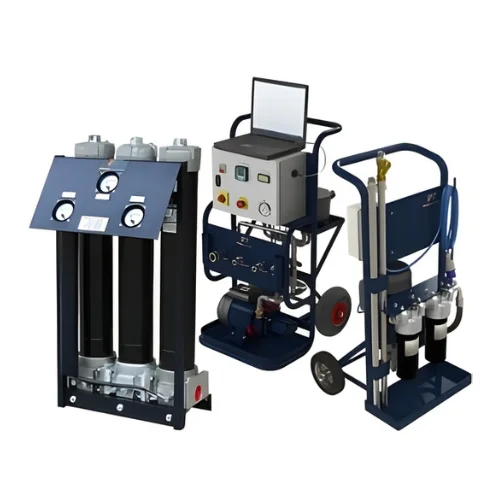
A bespoke portable unit combined a pump selected for the viscous oil, a magnetic strainer and a fine filtration stage. The setup addressed contamination at several handling steps before the machines entered service.
The useful lesson is to treat filling and commissioning as part of contamination control, and to select the equipment for the actual oil temperature.
The case describes the application and equipment, with qualitative reports of improved cleanliness. It includes no before-and-after particle counts, water results or quantified savings. The 3 µm figure is the filter rating, not the cleanliness achieved in the oil.
Source: Filtertechnik, gearbox-oil filtration case for a tunnel-boring-machine manufacturer. Customer and country are not disclosed. The source attributes the equipment solution to Filtertechnik; it does not identify NATCOM as the delivery provider.
Discuss temporary filtration for a contamination event, oil transfer, machine assembly or commissioning. The proposal defines equipment, access, operation, sample checks and the agreed endpoint.
Include the maintenance window and operating restrictions so the team can confirm a suitable field arrangement.
A separate circulation loop can suit recurring contamination or a continuing cleanliness requirement. Selection includes the oil, connections, inspection needs, filter changes and sampling routine.
Explore oil-management equipmentFor water-contaminated oil, Filtertechnik lists Neptune equipment for free and entrained water removal, including gearbox-oil applications. The fluid, viscosity and water condition still determine suitability; those capabilities are not a guarantee for an untested system.
Review the oil, service history and gearbox symptoms. Take a representative sample and agree which measurements will define a useful result.
Match pump, hoses, filter media and water-removal equipment to the actual fluid and temperature. Agree site access and whether the work fits an outage or a separate operating loop.
Circulate or transfer the oil through the selected equipment. Monitor flow, filter loading and sample results, while addressing the source of contamination.
Compare the starting and final measurements using a consistent sampling method. Record the equipment, operating conditions, result and any further maintenance needed.
The report should make the starting condition, target and final result easy to compare. Particle cleanliness, water content and oil chemistry answer different questions. Use the gearbox manufacturer's requirements and the service context to interpret them.
Send what you already know. Oil volume, viscosity, contamination, treatment target, access and filter consumption affect cost and timing. Available results help the team define the next step.
Regional delivery
Each job is scoped for the lubricant, gearbox and site conditions. Egypt services are available; Saudi Arabia is coming soon.
We provide solid-particle filtration, water removal, varnish removal and oil sampling to the clients of ExxonMobil, as their sole service partner as well as directly to our wide range of clients.
Discuss upcoming Saudi gearbox oil filtration and water-removal requirements with NATCOM. The team will confirm the oil, viscosity, treatment target, access and equipment setup before arranging service.
For other oil circuits, see hydraulic oil filtration, turbine oil filtration and the broader industrial oil filtration service.