
The bearing is difficult to reach, and the manual greasing round keeps slipping. An automatic lubricator may improve the delivery arrangement. It still needs a defensible answer to a basic question: what should this point receive, under this machine's actual duty?
Choose automatic greasing around the lubrication point, the approved lubricant, the required quantity and timing, and the proposed delivery path. Then confirm that the equipment can deliver that requirement and that someone will inspect its operation. A larger cartridge or a connected dashboard cannot settle the lubrication requirement.
The maintenance decision is to replace an uncertain delivery practice with a defined and checked one. Start with the current lubrication schedule, equipment guidance and operating history. If the existing quantity or interval is uncertain, settle it during the application review rather than copying it into a new device.
Define each point before choosing the unit
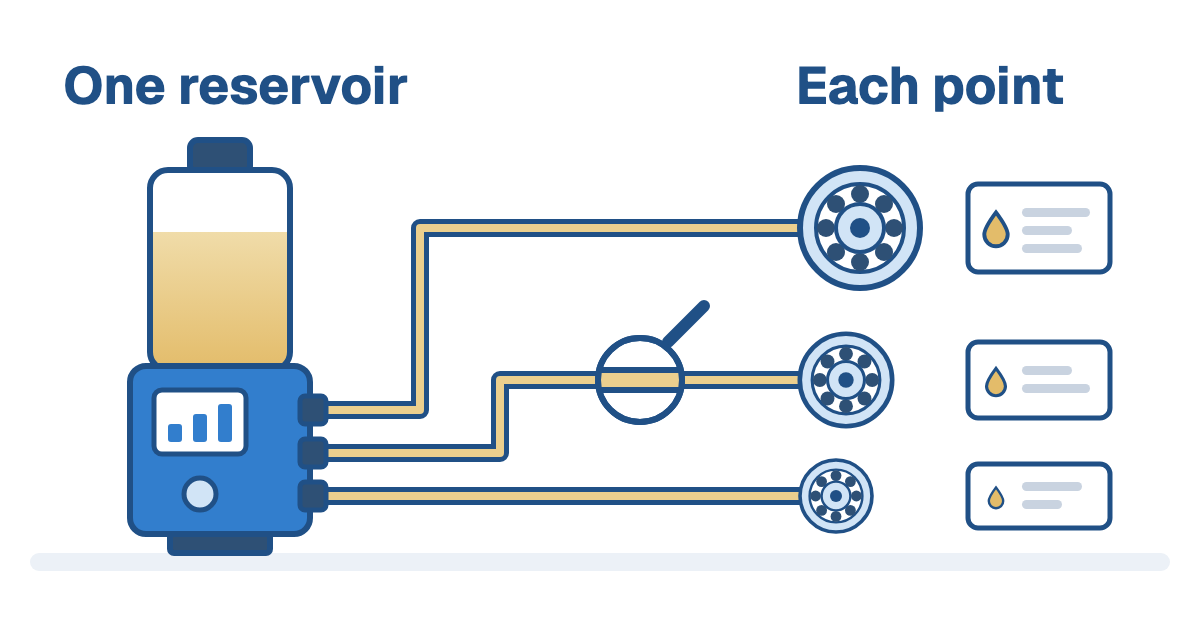
List the lubrication points individually. Include the bearing or other component, lubricant identity, current quantity and interval, operating duty, access arrangement and any recurring symptoms. Keep points with different requirements distinct, even if they sit on the same machine.
Check whether the proposed lubricant is acceptable for the component and compatible with the installed lubricant and delivery equipment. An empty cartridge permits a lubricant choice; it does not establish that every grease will work in the application. The supplier should confirm the selected lubricant against the device and the point requirements.
Do not use a reported noise or vibration change as a licence to add an arbitrary quantity. First establish whether insufficient lubrication is supported by the evidence. The pump and motor monitoring case is a useful reminder that an assembly can have a lubrication concern and damaged bearing metal at the same time.
Compare outlets, delivery and the line arrangement
A single-point arrangement and a multi-point arrangement answer different installation needs. Schaeffler's OPTIME C4 one-page brochure documents four individually programmable outlets and a maximum outlet pressure of 70 bar. The relevant selection question is whether each proposed outlet and delivery path can support its assigned point.
The pressure specification is a device limit, not a recommended pressure for every bearing or a guarantee that any length of grease line will work. Ask for the line arrangement, lubricant, temperature conditions and application confirmation behind the proposal. Avoid deciding remote installation suitability from the headline pressure alone.
Cartridge capacity also needs context. Schaeffler's ecosystem brochure distinguishes C4 grease cartridges of 400 or 750 cubic centimetres from an 850-cubic-centimetre oil tank. The one-page brochure lists those capacities together. Do not describe the oil-tank capacity as an 850-cubic-centimetre grease cartridge. Confirm the actual reservoir and lubricant combination in the quotation.
Program the requirement, not the cartridge lifetime
A cartridge replacement date is useful for planning. It does not define how much lubricant a component should receive. Work from the established point requirement to the proposed setting, then record how that setting relates to the device's metered delivery.
For a machine that does not run continuously, discuss how the delivery arrangement relates to its actual operating schedule. The C4 one-page brochure documents an on/off function and individually programmable outlets. Those capabilities still need a setting and operating procedure that fit the machine.
Keep the configuration record with the lubrication schedule. After a cartridge or lubricant change, check the relevant settings and installed arrangement rather than assuming the previous setup still answers the application. Do not derive a universal dose or dispensing interval from a brochure example.
Keep inspection in the programme
Automatic delivery changes the maintenance task. The team still needs to check device status, remaining lubricant, delivery lines and the condition of the lubricated component. Define who responds to a warning and what evidence confirms that delivery resumed.
The C4 brochure documents cartridge recognition, a lubricant-quantity display and a high-back-pressure warning. These can support inspection and replenishment planning. A warning helps identify a delivery concern; it is not proof that the problem has corrected itself or that the bearing has received the required amount.
Keep condition monitoring and delivery monitoring distinct. A device can report its lubricant status while a damaged component still needs work. Conversely, an abnormal machine trend should prompt a review of its cause, not an automatic assumption that the cartridge needs replacement.
Use the outcome to check the diagnosis
At WEIG's cardboard plant, Schaeffler and its partner KSA Kubben & Steinemer used OPTIME sensors on the motor and pump, with two C1 lubricators serving the motor. The source identified insufficient motor lubrication. Controlled lubrication returned the reported motor-bearing indicators to normal.
The pump had a different finding. Analysis indicated inner-ring damage, which inspection confirmed on the removed bearing. Lubrication did not repair that damaged pump bearing. The account supplies no numerical vibration improvement or follow-up duration, and its C1 installation should not be relabelled as a C4 project.
Prepare a point list, lubricant details, current schedule, line distances and operating duty for NATCOM. Add the available condition trends and any delivery problems. Use that information to compare automatic lubricators and greases and define installation, settings, inspection and verification together.

Frequently asked questions
Define each point's approved lubricant, quantity, interval, operating duty and delivery path first. Then verify the proposed device and configuration against those requirements and assign inspection responsibilities.
Cartridge replacement planning does not establish the component's lubrication requirement. Work from the required quantity and interval to an appropriate device setting.
No. Schaeffler states 70 bar as the C4 maximum outlet pressure. The actual lubricant, line arrangement, temperature and point requirements still need application confirmation.
The ecosystem brochure lists 400 and 750 cubic centimetre grease cartridges and an 850 cubic centimetre oil tank. Confirm the correct reservoir and lubricant combination rather than treating the largest figure as grease capacity.
Correct delivery can address a confirmed lubrication shortfall. It does not repair damaged bearing metal. Schaeffler's WEIG case documented separate motor-lubrication and pump-bearing actions.