
01 / The challenge
Slower rams were putting part quality at risk.
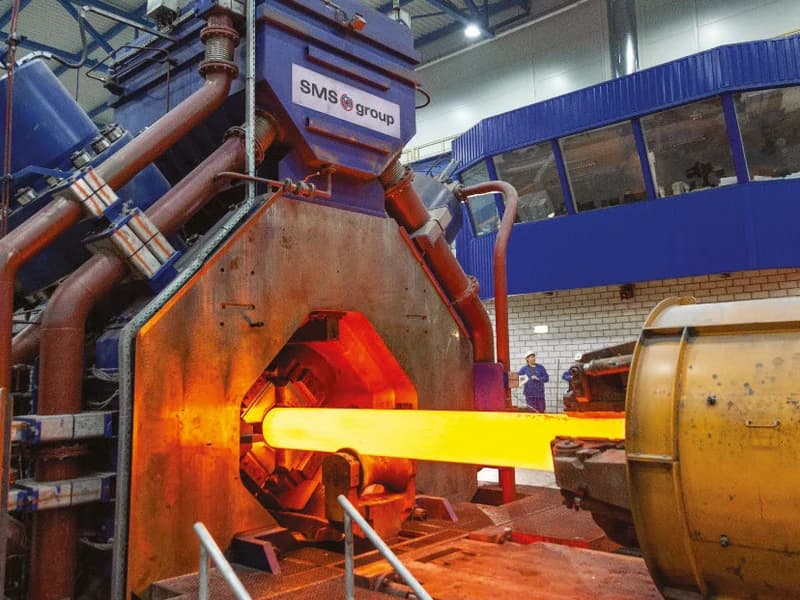
An aerospace component manufacturer operated a hydraulic radial forging press with four 12,000-gallon reservoirs. Each reservoir supplied one of the press's four cylinders. A drop in ram speed made operation inconsistent and threatened product quality.
Inspection found a manifold covered in varnish deposits. Pumps, valves and other internal parts also carried deposits, while oil analysis confirmed high varnish potential. The maintenance problem extended through the hydraulic circuit.
The priority was to recover reliable press response. The team chose to treat the oil already circulating through the machine, so the treatment could reach the affected components across all four reservoirs.
02 / The approach
Use the circulating oil to reach the deposits.
Confirm deposits across the system
Inspection found varnish in the manifold, pumps, valves and other internal components. Oil analysis also showed high varnish potential, connecting the fluid condition with the loss of hydraulic performance.
Circulate treatment through all four reservoirs
DECON™ was added at 3% to the existing hydraulic oil and circulated through all four reservoirs. The concentration was selected for this press and its fluid condition.
Follow the oil and inspect the components
The manufacturer continued monthly fluid monitoring, including membrane patch colorimetry, or MPC, to track varnish potential. Component inspection one month after treatment checked whether the deposits were dissolving.
03 / The documented outcome
Ram speed recovered and productivity rose by 8%.
Within one week, varnish potential had fallen and press performance had returned. The rams recovered their speed, valves stopped sticking and heavily varnished components began to clean. Fluitec records an 8% productivity improvement for the manufacturer.
At the one-month inspection, significant amounts of deposit had dissolved from the components. The manufacturer continued monthly oil checks and planned to maintain approximately 3% DECON™ when adding replacement oil during routine top-ups.
- Productivity
- 8% increase reported
- Press response
- Ram speeds restored; valves stopped sticking
- Oil condition
- Varnish potential lowered within one week
- Component inspection
- Significant deposit dissolution after one month
04 / Applying the findings
Check the fluid when hydraulic response changes.
This press had physical deposit evidence as well as poor operating response. For another system, start with the ram-speed or cycle-time history, valve replacement records and available component photographs. Combine those observations with oil analysis to decide whether fluid degradation belongs in the investigation.
An assessment should establish whether the oil remains suitable for treatment, whether the proposed chemistry is compatible with the system and how success will be checked. Record the operating response before treatment, then compare it with repeat samples and machine performance afterward. The article on hydraulic varnish and servo-valve sticking explains how the same problem can appear as slow cycles or unreliable start-ups.
Where particle or water contamination is also present, hydraulic oil filtration can form part of the assessment. Match the response to the contaminants and deposits found in the system, then follow whether the operating improvement holds.