The press is slower than it used to be. Not broken, not alarming, just slower. Cycle time has stretched by a second or two, the operators have started building that into their expectations, and somebody on the morning shift has learned which valve to tap before the first cycle of the day.
That machine is not failing. It is reporting. And what it is reporting is usually treated as a machine problem, which brings a machine response: replace the servo valve, rebuild the pump, schedule an overhaul, or accept the new normal. On three documented hydraulic systems, the cause was not in the machine at all. It was in the fluid, and treating the fluid brought the production rate back.
Start by putting the production loss and the maintenance history on the same timeline. Record when cycles became longer, whether repeatability changed, and what happened after the last valve repair or replacement. If the improvement was temporary, that is a reason to widen the investigation to the fluid and the rest of the system. Repeating the same repair without that comparison leaves the team with little explanation for why the symptom returned.
Slow response alone does not establish varnish as the cause. The inspection findings and oil tests need to support that diagnosis before treatment is selected. The documented systems in this article show why deposits belong in the investigation: the losses appeared in everyday production, and the reported improvements followed work on the fluid. Understanding how deposits interfere with control surfaces helps connect those two observations.
What the machine is actually telling you
Deposits form on the surfaces that meter and control flow. Servo valves feel it first because their clearances are the tightest in the system, so it takes very little material to change how they respond. The result is sticking, hysteresis, chatter and accelerated wear.
Translated into the language of a production meeting, that is four things.
The machine slows down
Ram speed drops, clamp speed falls off, and the cycle takes longer than it did last year. Nothing has broken, so nothing gets raised.
Repeatability drifts
Shot-to-shot and part-to-part consistency loosens. Precision falls and the scrap rate climbs before anyone connects it to the hydraulics.
Start-up becomes a job
Valves stick on the first cycle of the morning. The fix becomes a routine: free it, replace it, get the line running, do it again next week.
The system runs hotter
Deposits foul the heat exchanger, so cooling falls away and the oil runs warmer, which produces more deposits. The loop tightens on itself.
None of these is dramatic on its own. Together they are a machine losing capability, and they are what deposits do to a production line: loss of clamp speed and cycle time, reduced repeatability and precision, and longer setup and maintenance times.
Why modern hydraulic systems varnish more easily
This is worth understanding, because one's instinct is to assume the oil got worse. It didn't. The oil got better, and the system around it became harder to run.
Smaller reservoirs, same duty
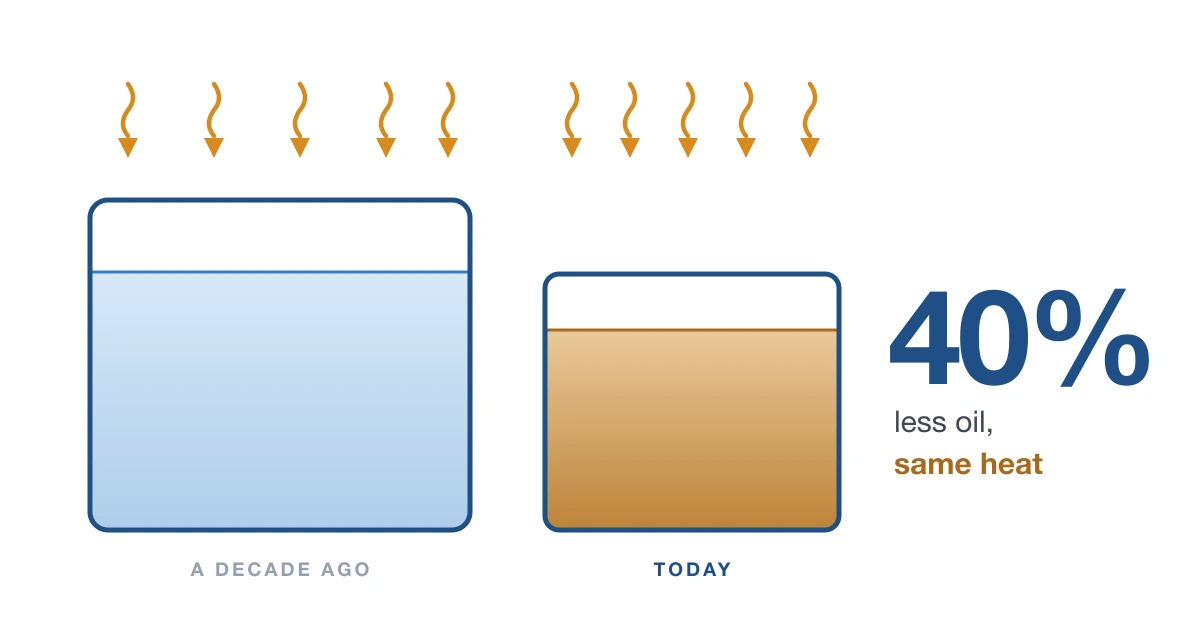
Equipment manufacturers have cut sump sizes by as much as 40% over the last decade. Less oil absorbs the same heat and shear, so every liter works harder and ages faster.
Cleaner base oils hold less in solution
High-purity Group II and III base oils resist oxidation better than the Group I oils they replaced, but they dissolve degradation products less well. What the old oil carried in solution, the new oil drops out as deposits.
Hydraulic systems also have degradation routes that a turbine reservoir largely does not. Microdieseling is entrained air imploding under compression at local temperatures above 1,000 °C, and electrostatic spark discharge reaches up to 10,000 °C. Both cook small volumes of oil into deposits. This is how a system can build varnish while the bulk oil temperature on the gauge looks entirely reasonable, which is often the reason the possibility gets dismissed early.
The tests most plants run will not warn you
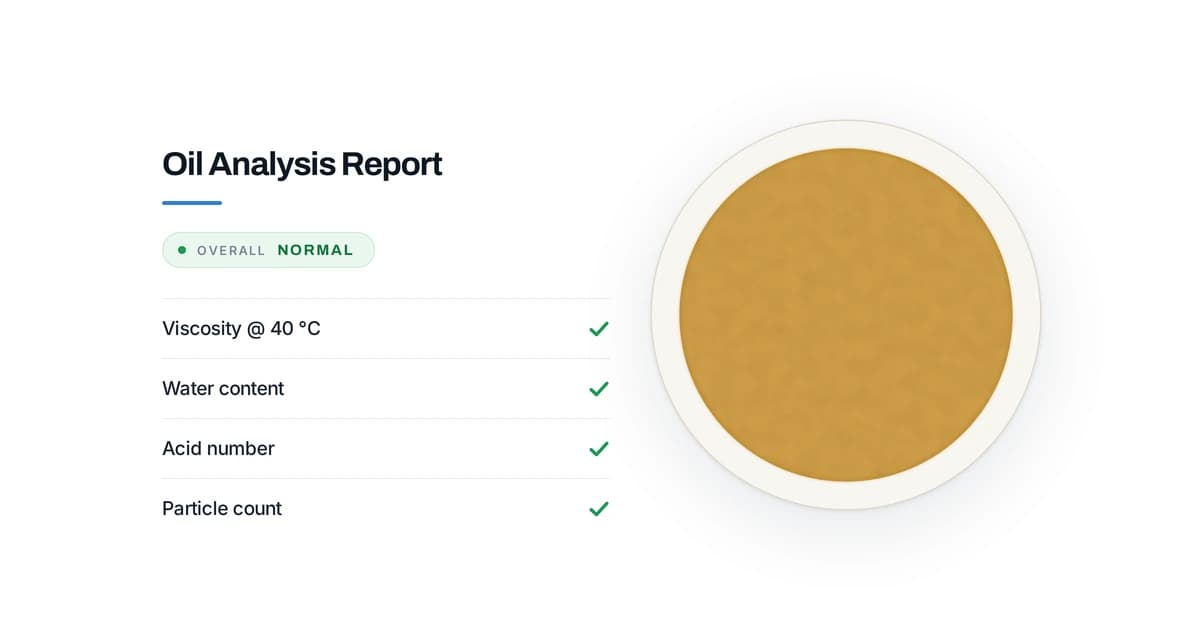
Viscosity, acid number and elemental spectroscopy will not detect this kind of degradation, and running them more often does not help. Viscosity moves for several reasons. On Group II and III oils, acid number tends to rise only once the antioxidants are already gone, which is too late to act on. Elemental spectroscopy reports wear metals rather than the health of the additives.
The two that do the job are Membrane Patch Colorimetry, ASTM D7843, which measures the fluid's propensity to form deposits, and voltammetry, ASTM D6971, which measures how much antioxidant protection remains. We covered the reasoning behind that pair in more depth in what a normal-looking oil report can miss.
Three systems where treating the fluid restored the machine
Three separate customers, three sectors. Read them as single-account outcomes, not as a rate you should expect.
Hydraulic radial forging press
Aerospace componentsSymptom
Ram speed decreasing, inconsistent performance, product quality at risk
Fluid result
MPC 53 to 6 in about a week, then around 9 to 10
8% machine efficiency
1,000-ton injection molding machine
Plastics manufacturingSymptom
Servo valves seizing at every morning start-up, heat exchanger plugged, oil at 60 °C
Fluid result
MPC 40 to 11 in two and a half hours, reservoir below 37 °C within a day
5% productivity, 14% fewer man-hours
Hydraulic steel presses
Automotive manufacturingSymptom
Valve sticking, repeat pump failures, seal locks, no oil analysis in place
Fluid result
Valve sticking stopped and the system was reported varnish free
$1.3M saved, 7,570 liters of oil
The forging press: ram speed came back
An aerospace component manufacturer ran an SMS Group hydraulic radial forging press built around four 12,000-gallon reservoirs, one per cylinder. Ram speed had dropped, performance was inconsistent and part quality was at risk. Inspection found a manifold full of deposits, with more in the pumps, valves and internals. Oil analysis put varnish potential at an MPC of 53.
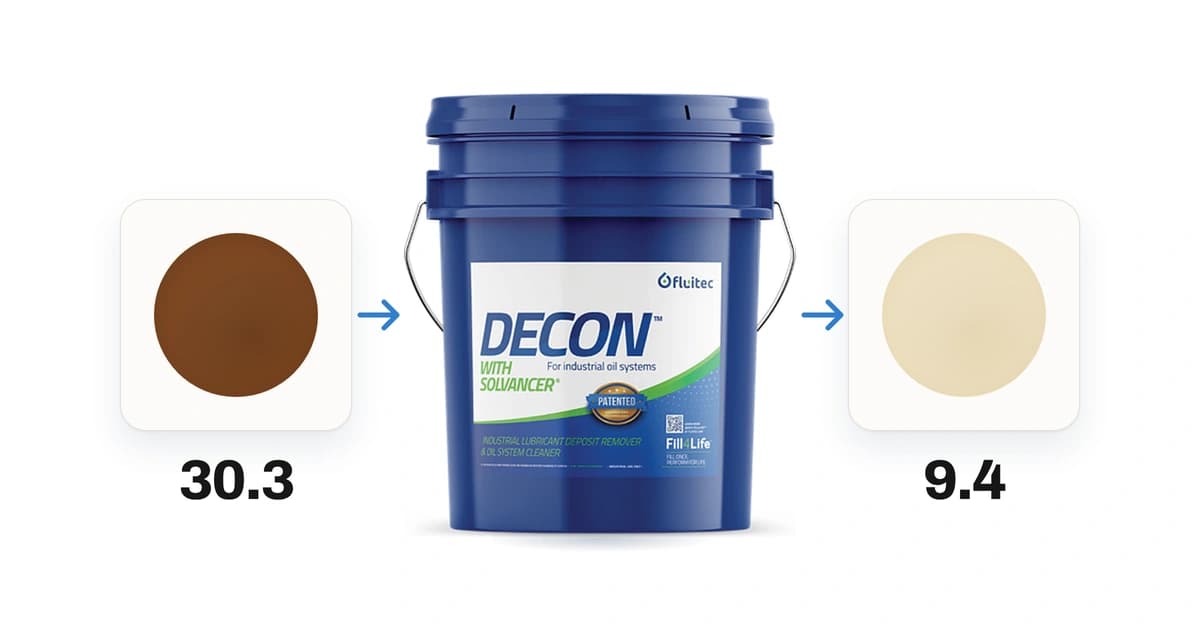
DECON™ was added at a 3% treat rate to the in-service oil and circulated through all four reservoirs. Within about a week MPC had fallen to 6, with subsequent readings of 10, 9 and 9. Ram speeds were restored, valves stopped sticking, and a component inspection a month later showed that significant amounts of deposit had dissolved. Machine efficiency was recorded 8% higher.
The molding machine: two and a half hours
A plastics manufacturer ran a 1,000-ton injection molding machine that seized servo valves on the morning start-up, often enough that valve replacement had become routine. The heat exchanger was plugged, the oil was running at 140 °F (60 °C), and the internals were coated in brown, sticky varnish.
DECON™ was added to the reservoir with the machine in operation. Membrane Patch Colorimetry fell from 40 to 11 within two and a half hours. Inside 24 hours the heat exchanger was working again and the reservoir had cooled to below 100 °F (37 °C). Applied to that temperature drop, the Arrhenius rate equation gives more than four times the oil life, though that is a calculation rather than a measured result. What the plant measured was productivity up 5%, maintenance man-hours down 14%, no further servo-valve replacements, and around 5,000 pounds a year of waste oil disposal avoided.
The press line: the cost of not measuring
A major automobile manufacturer in the Czech Republic and Slovakia ran hydraulic steel presses that suffered valve sticking, repeat pump failures and seal locks. The detail that matters most here is that no oil analysis was being performed, so the problem arrived unannounced every time. Existing varnish-mitigation equipment consumed filter elements heavily, and MPC climbed again as soon as it was disconnected.
MPC testing was folded into the condition-monitoring program, the fluid treated at 3% DECON™, then DECON™ AW added to hold antioxidant and antiwear levels. Valve sticking stopped and the system was reported varnish free. The recorded saving is $1.3M for that customer, along with 2,000 gallons, or 7,570 liters, of oil not purchased. That is one site's figure and should not be read as a rate that transfers.
What this means for a plant in Egypt or Saudi Arabia
Those cases were recorded in the United States and central Europe, but nothing in the mechanism is regional. The sectors where it bites hardest, plastics and injection molding, steel and metal forming, automotive components and forging, all operate across Egypt and Saudi Arabia.
Two local conditions push in the wrong direction. High ambient temperatures raise the thermal load carried by an oil charge that the equipment manufacturer has already made smaller. Dust ingress adds contamination that the filtration has to keep up with. Neither is measured in the cases above, and neither replaces a sample from your own system. They simply mean the conditions that produce this problem are present, and that a European or North American oil-change interval should not be assumed to transfer unchanged to a plant in Cairo, Alexandria, Riyadh or Dammam.
What to do before the next valve replacement
- Write down what the machine has lost. Cycle time now against cycle time when the machine was new or last overhauled, scrap rate, valve replacements in the last twelve months, and how many of them were on the same machine. This is the evidence that turns a vague sense of decline into a number worth investigating.
- Test the fluid for the right thing. A standard report will not answer this. Ask specifically for deposit potential and remaining antioxidants alongside the usual cleanliness and water results. One sample is a snapshot, so record the operating conditions and plan to repeat it.
- Look inside where the deposits show first. Servo-valve spools, the manifold, the heat exchanger and the reservoir walls. Photograph what you find. In all three cases above, the physical evidence and the oil result told the same story, and that agreement is what justified acting.
- Choose the response, then verify on the machine. Depending on what the evidence shows, the answer may be component work, hydraulic oil filtration, deposit treatment, an oil change, or a combination. Check compatibility and the equipment manufacturer's requirements first. Then confirm the result on cycle time and valve behavior, not only on the next oil report. A better MPC number matters most when the machine agrees with it.
NATCOM's Oil Care Technologies cover the testing, contamination control and deposit-treatment options behind that decision, and the oil analysis service can define the evidence set before anything is dosed. The measurement comes first, because it decides which of the rest you actually need.
Slow is a symptom
The reason this problem runs for years is that it never presents as a fault. It presents as a machine that is a bit slower than it was, on a line that still makes parts, in a plant with more urgent things to look at. The decline gets absorbed into what the machine is expected to do.
The useful move is to treat lost speed as a measurement rather than a fact of life, and to check the fluid before signing off another valve. On one of the machines above, the number that mattered moved before the shift ended.

Frequently asked questions
Possible causes include deposits on the spool and sleeve, silt and hard-particle contamination, water, mechanical wear, actuator or driver faults, and control problems. Varnish is a common cause because servo-valve clearances are among the tightest in the system, so a very thin deposit layer is enough to change how the valve responds. Inspection, valve response data and suitable oil analysis are needed to separate a fluid problem from a mechanical or electrical one.
Deposits build gradually on the surfaces that meter and control flow, and they foul heat exchangers so the system runs warmer. Response slows, cycle time stretches and repeatability loosens, but nothing trips or breaks. Because the change arrives over months, it is usually absorbed into the normal expectations for the machine rather than investigated.
Modern oils resist oxidation better, but two changes work against deposit control. High-purity Group II and III base oils dissolve degradation products less readily than the Group I oils they replaced, so those products come out of solution as deposits. And equipment manufacturers have reduced sump sizes by as much as 40% over the last decade, so a smaller oil charge carries the same thermal load.
Often not in time. Viscosity, acid number and elemental spectroscopy are the wrong instruments for this. Viscosity moves for many reasons, acid number on Group II and III oils tends to rise only after the antioxidants are already depleted, and elemental spectroscopy reports wear metals rather than additive health. Membrane Patch Colorimetry, ASTM D7843, measures the propensity to form deposits, and voltammetry, ASTM D6971, measures remaining antioxidants.
Microdieseling is entrained air imploding under compression inside the fluid. Local temperatures exceed 1,000 °C during that implosion, which cooks small volumes of oil into carbonaceous deposits. It matters in hydraulics because air entrainment is common, and it explains how a system can generate deposits without ever showing a high bulk oil temperature on the gauge.
In the cases described here the treatment was added to the reservoir with the system in service, and no shutdown, flush or oil change is reported. Those are documented single-system outcomes rather than a standard method. Oil formulation, reservoir volume, filtration, contamination, system condition, compatibility and the equipment manufacturer's requirements all need reviewing first.
The mechanism does not change by geography, and the sectors where it bites, plastics, steel, automotive and forging, are all present across Egypt and Saudi Arabia. High ambient temperatures raise the thermal load on a smaller oil charge, and dust ingress adds contamination that filtration has to handle. Those conditions strengthen the case for measuring, but only an oil sample from your own system tells you where it stands.