
01 / The challenge
The test needed to distinguish particles from bubbles.
Hyster Yale Material Handling needed repeatable checks on gearboxes destined for off-highway and material-handling vehicles. End-of-line testing means checking the completed gearbox before it leaves the production process. Oil cleanliness was part of that acceptance decision.
During early gearbox operation, gears and clutches released both contaminant particles and air bubbles into the oil. Incotech, the engineering company developing the test bench, needed a measurement that could work under those conditions. Bubbles complicated the readings from particle counters the team had previously tried.
The circuit also imposed practical constraints. Oil passed from a one-inch pipe to a 6 mm inlet and returned at a low-pressure point. The design needed to measure cleanliness within that arrangement, without adding a high-pressure system simply to suppress bubbles before counting.
02 / The approach
Measure oil in a bypass from the lubrication circuit.
Integrate the sensor into the test bench
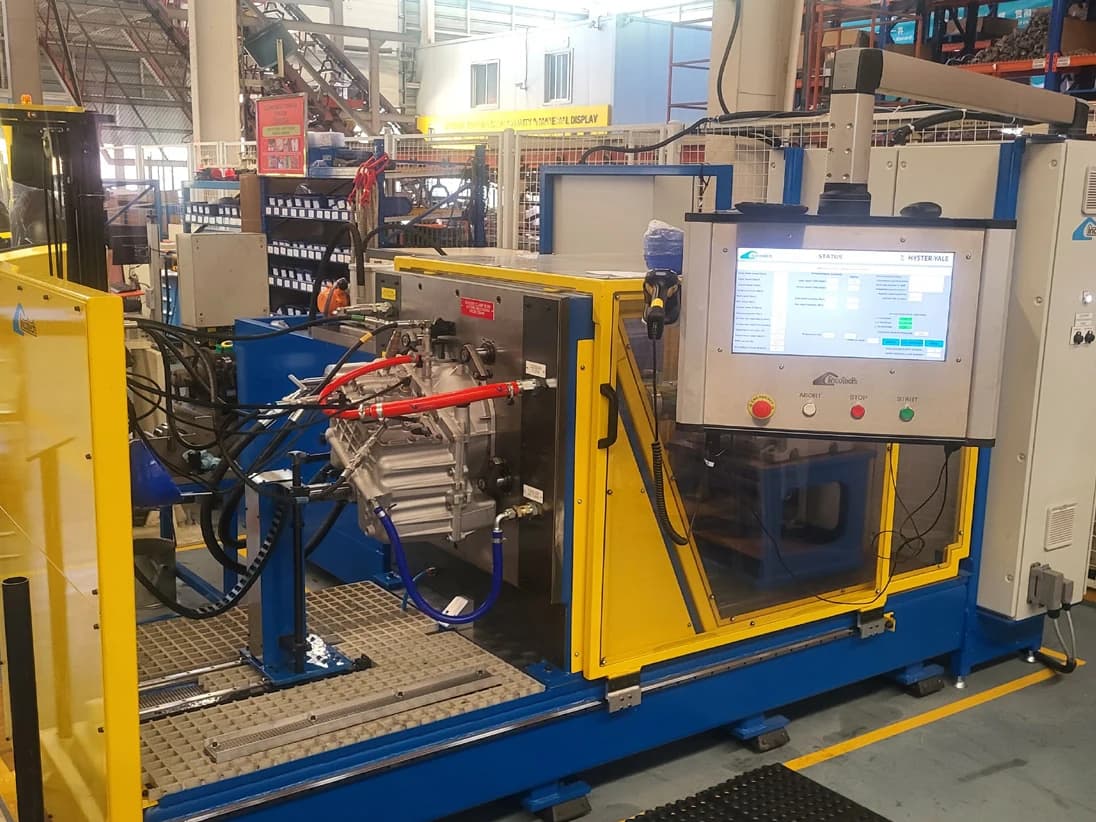
Incotech installed an Atten2 OilWear S sensor on a bypass from the cooling and lubrication circuit. The arrangement drew oil from the operating system for real-time measurement and returned it at a low-pressure point.
Separate bubbles from contamination
The sensor distinguished air bubbles from solid particles in this application. That distinction allowed the bench to assess particle contamination while the oil remained aerated, meaning it still contained dispersed air bubbles.
Record useful cleanliness measurements
The sensor provided particle and bubble counts, particle-size distribution and ISO 4406 cleanliness codes. These codes summarize particle concentrations in defined size bands. The information supported consistent gearbox cleanliness checks through the test process.
03 / The documented outcome
The team could test without waiting for bubbles to settle.
The case reports more consistent particle counting under foamy or bubbly conditions and reduced testing time because operators no longer needed to wait for air bubbles to settle. It also describes a simpler bench design, with no high-pressure bubble-suppression system needed for this sensor arrangement.
The bench could assess cleanliness while the oil remained aerated, keeping the measurement aligned with actual test conditions. The reported gain was a more consistent basis for the gearbox acceptance decision and better confidence in the test rig's output.
"With Atten[2]'s OilWear S, we get reliable results even when the oil looks like cloudy beer."
04 / Applying the findings
Match the measurement to the oil circuit.
A particle-counting specification should describe the fluid the sensor will see. Include the oil grade, expected temperature, pressure, flow and tendency to aerate. Explain whether readings will support a manufacturing acceptance decision, an alarm during operation or a filtration check. Those tasks can require different installation and verification arrangements.
A changing particle count still needs investigation. Bubbles and wear debris can occur together, so identifying air interference does not establish that the oil is clean. Agree how the selected instrument will distinguish the relevant signals and how questionable results will be checked before setting pass or fail criteria.
Read how air bubbles can distort an oil particle count for the broader measurement question. NATCOM's oil-management equipment and oil-analysis service support discussions about suitable instruments, sampling and interpretation.