A gearbox test begins and the oil particle count climbs. The oil looks cloudy, the cleanliness result is outside the expected range, and the team faces a decision. Repeat the test, change the filter or stop the job? Before acting on the number, establish what the instrument is counting.
Air bubbles can distort oil particle counts with some optical methods and measurement arrangements. That does not make every high reading false. Bubbles and genuine wear particles can circulate together. A useful investigation separates the measurement question from the machine-condition question, then brings the evidence back together.
How air bubbles can become particle-counting events
A light-obscuration particle counter sends a beam through a small flow of oil. As material passes through, the detector measures changes in the light reaching it. The instrument converts those signals into counts and size ranges. This is a measurement of an optical event, not a chemical identification of what passed the detector.
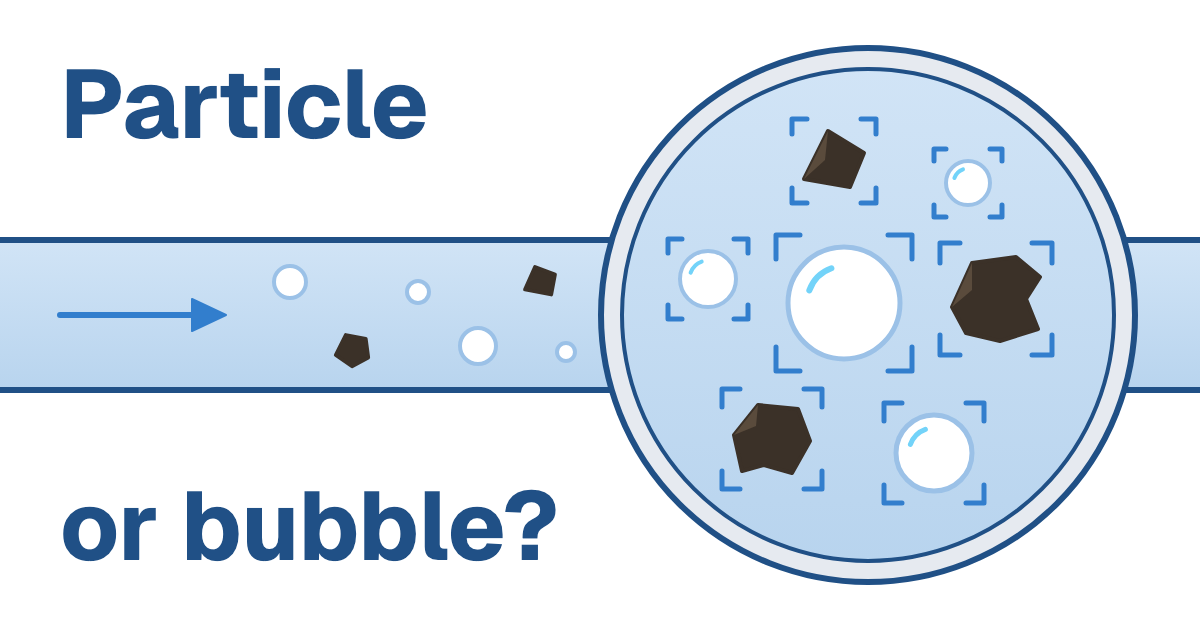
Air bubbles can also alter the light signal and be recorded as particle-like events. The effect depends on the method and measurement arrangement. An ISO 4406 cleanliness code summarizes the count in specified size ranges; it does not establish that every event came from solid debris. That is why a false high oil particle count is possible in aerated oil, meaning oil containing dispersed air.
Different systems address the problem differently. Some use controlled sample preparation or a suitable pressure arrangement to manage bubbles. Image-based instruments can use captured fluid images to distinguish particles from bubbles. Ask how the proposed counter handles the actual oil conditions and how that capability will be checked for your application.
Check the measurement before dismissing the alarm
Record when the change occurred. Was it at startup, during a load change, after maintenance or when the sampling arrangement changed? Put the count beside the operating record. A repeated association gives the team something to investigate, but it is not proof of the cause on its own.
Check the sample point, temperature, flow and pressure against the instrument's requirements. For a laboratory sample, ask how handling and preparation address the oil's condition. For an installed sensor, examine the measurement loop and return connection. Work within the manufacturer's procedure; changing pressure or sample preparation without recording it can make comparisons misleading.
Then ask for a suitable independent check of the suspected particles. Depending on the question, laboratory particle examination or wear-debris analysis can help establish what is present. If temperature, vibration or inspection also points to distress, retain that evidence. Visible bubbles are not a reason to wave away a possible wear event.
A clear sample bottle is not a preparation method
Bottle sampling creates its own difficulty. Particles can settle, so the laboratory needs a representative distribution before counting. Mixing redistributes them but can introduce air. Simply waiting until a bottle looks clear does not establish that both problems have been controlled.
Ask for the instrument's validated mixing and de-aeration procedure. De-aeration means removing dispersed air before measurement. The method must suit the oil's viscosity and the equipment. Record preparation changes when comparing results, and avoid improvising a waiting period or pressure setting. Otherwise, a lower count may reflect different sample handling rather than cleaner oil.
How a gearbox test bench handled bubbly oil
Hyster Yale Material Handling needed repeatable end-of-line testing for its gearboxes. Early operation released both particles and air bubbles, making cleanliness measurement difficult with the previous arrangement. Incotech Ltd built a custom test bench and integrated an Atten2 OilWear S sensor into a bypass from its cooling and lubrication circuit.
The bypass returned oil at a low-pressure point. In that environment, the sensor distinguished bubbles from the particle count. Atten2, a NATCOM technology partner, reports that the arrangement removed the need to wait for bubbles to settle and simplified the bench's measurement setup. The result was repeatable testing under the application's aerated conditions.
Read the gearbox oil particle-counting case study for the installation and reported outcome. Its useful lesson is to qualify the measurement for the process in which the oil actually circulates.
Specify the oil conditions as well as the output
A procurement request that asks only for an ISO cleanliness output leaves important questions open. Describe the oil, viscosity, expected temperature and pressure, operating cycle and observed aeration. State whether the result will support a continuous trend or a pass-or-fail decision at a particular stage of testing.
Ask suppliers to explain bubble handling and the limits of the proposed method. Agree how suitability will be demonstrated for the application and what reference checks will be used. Also decide how invalid readings, interruptions and changes in operating condition will appear in the record. A number without that context can be difficult to defend later.
For example, the OilWear family uses images of the fluid to distinguish particles and bubbles. That capability is relevant to an aerated measurement problem. It does not remove the need to select a suitable model, installation and interpretation procedure, or establish the cause of every particle detected.
Keep bubble behavior in the monitoring record even when the counter can exclude it from the particle result. Ask whether the observed aeration is expected for that operating stage and what the equipment team wants investigated. A reliable particle number resolves the counting problem; the reason for a change in bubbles may still need attention.
Make the result usable for the acceptance decision
For a test bench, define which stage of the operating cycle supplies the acceptance reading. Record the oil condition, method and any rejected measurements with the gearbox identifier. That gives the next reviewer a reason to trust the result and a way to investigate a disagreement without repeating tests blindly.
Online monitoring and laboratory analysis can contribute different evidence. Our guide to whether an oil-analysis package is good enough covers the wider program. Here, the immediate job is to establish a reliable particle measurement under the conditions in which the plant will use it.

Frequently asked questions
Yes, bubbles can interfere with some optical particle-counting methods and measurement arrangements. Whether they affect a result depends on the instrument, fluid and measurement conditions. Confirm the method and installation before treating an apparent increase as either real contamination or harmless interference.
No. Air bubbles and real particles can be present together. Check particle and bubble information separately where available, and use suitable confirmatory oil analysis and machine evidence to investigate the condition.
It summarizes particle concentration in specified size ranges. It does not by itself identify particle material or explain a change. A code should be interpreted with the counting method, sampling conditions, oil history and equipment requirements.
No. An online sensor gives repeated information about the properties it measures. Laboratory tests can answer separate questions about lubricant chemistry, water, deposits or wear. Select both around the machine and the maintenance decision.