
01 / The challenge
Bring camshaft oil contamination back under control.
A Greek tanker operator found particle concentrations above the recommended levels in the camshaft lubrication system of an electronically controlled main engine. Keeping this oil clean was important to controlling abrasive wear on the camshaft.
The operator needed an effective way to remove contamination from the circulating oil. The response was to add offline filtration: a separate loop that draws oil through a treatment unit alongside the engine's lubrication circuit. Repeat sampling would show how the oil responded.
02 / The approach
Add a cleaning loop, then follow the oil.
Match filtration to the camshaft oil circuit
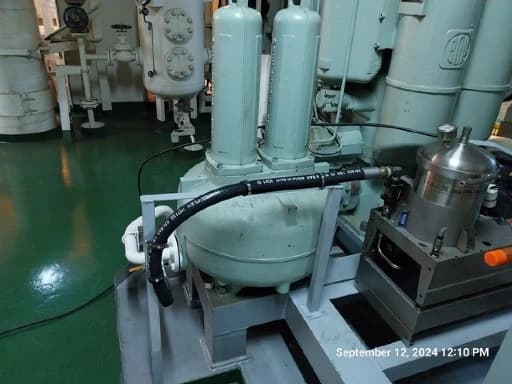
Hexagon Europe's marine technical representative recommended the Delta-Xero 1000 Series. A DX1001 unit was installed to provide a separate filtration loop alongside the engine's existing lubrication system.
Follow the particle counts through repeat samples
Oil analysis recorded particles larger than 4, 6 and 14 microns on 18 May, 11 June and 4 July 2023. Recording the lubricant hours alongside each result made the change traceable through continued operation.
Compare the trend across all three size bands
Particle concentrations fell in each size band at every sample. The repeated decline gave the operator evidence that contamination was reducing across the sampled period.
03 / The documented outcome
Lower particle counts at each successive sample.
Between the first and final samples, particles larger than 4 microns fell from 2,994 to 246 per millilitre. Counts above 6 microns fell from 2,700 to 246, while counts above 14 microns fell from 640 to 75. The reported cleanliness code improved from 19/19/16 to 15/15/13.
The lubricant-hour reading advanced from 2,487 to 3,015, a difference of 528 hours. The intermediate sample also showed lower counts in every size band. All particle counts below are per millilitre of oil.
- Lubricant hours
- 2,487
- Particles >4 µm
- 2,994
- Particles >6 µm
- 2,700
- Particles >14 µm
- 640
- Reported cleanliness code
- 19/19/16
- Lubricant hours
- 2,701
- Particles >4 µm
- 1,210
- Particles >6 µm
- 1,197
- Particles >14 µm
- 417
- Reported cleanliness code
- 17/17/16
- Lubricant hours
- 3,015
- Particles >4 µm
- 246
- Particles >6 µm
- 246
- Particles >14 µm
- 75
- Reported cleanliness code
- 15/15/13
04 / Applying the findings
Specify the target, the connections and the follow-up.
For another marine oil system, start with the engine maker's cleanliness requirements, lubricant grade, oil volume and operating temperature. Include the existing filters, purifier arrangement and available connection points when assessing an oil filtration system.
Agree how success will be checked before fitting equipment. Keep the sampling point and method consistent, record lubricant hours and compare successive results. Oil analysis can track cleanliness alongside the other properties needed to assess continued lubricant use.
This case gives a practical example of a filtration result supported by repeat measurements. When comparing filtration proposals, ask for the proposed connections, operating conditions, target cleanliness and verification plan so the offer matches the machinery.