
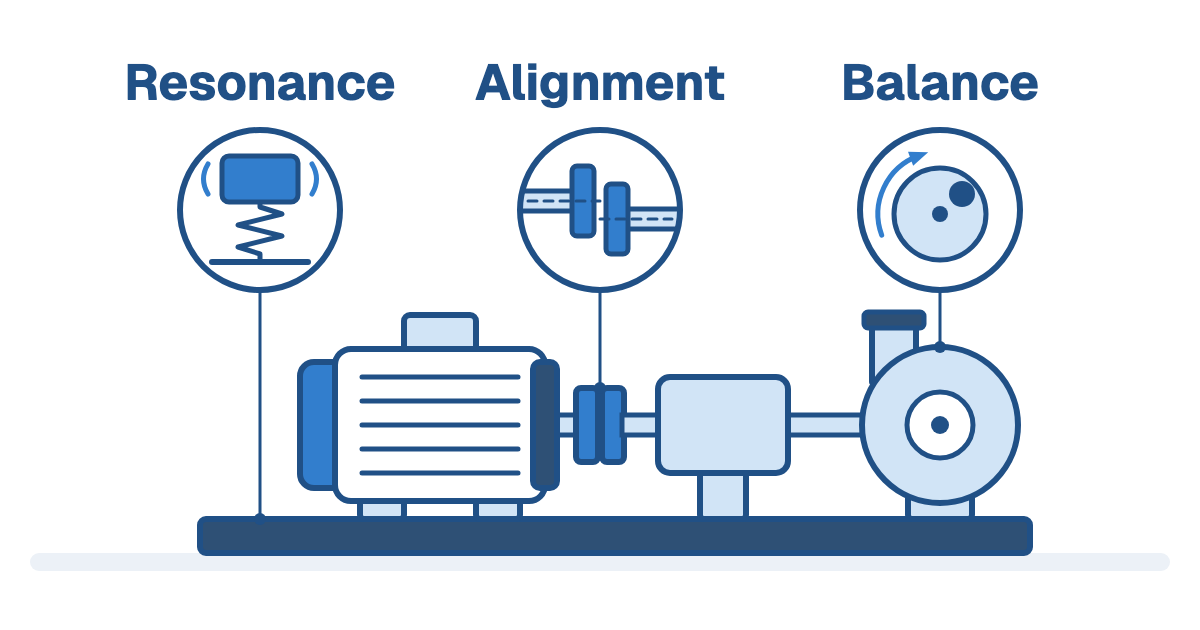
The fan is shaking again. It was balanced at the last shutdown, so balancing goes back on the work list. That is a reasonable hypothesis to investigate. It is not yet a diagnosis.
Balancing corrects an uneven distribution of rotating mass. Alignment corrects the relationship between coupled shafts. Resonance occurs when excitation acts near a natural vibration frequency of the machine or its supports and the response becomes large. These mechanisms can produce a similar visible complaint and need different evidence before corrective work is chosen.
The cost of guessing is another maintenance window with the original finding still present. A useful investigation should explain which mechanism the measurements support, which alternatives remain, and how the proposed action will be verified. Start with the operating history rather than the repair that is easiest to order.
Record what changed and where
Identify the affected machine, measurement points, directions, units and operating conditions. Keep the motor, coupling, driven equipment and supports distinct in the record. A high reading on one part does not establish that the rotor is responsible for the whole assembly's response.
Put the symptom beside recent events. Did it begin after cleaning a fan wheel, changing a coupling, replacing bearings, adjusting the base or returning the machine to operation? Does the vibration change across speed or load? The history helps the analyst choose the next measurement; it does not replace that measurement.
Keep the frequency spectrum with the overall reading where available. The spectrum separates vibration by frequency. A phase measurement describes the timing relationship of the vibration, against a reference or another measured point. Those records can provide information that one overall value cannot, especially when several possible causes remain.
Test the balancing explanation
If uneven rotating mass is suspected, ask which observations support it and what else was checked. A balancing proposal should state the rotating component, relevant operating condition and the measurements used to assess its response. Do not authorize correction weights only because the machine looks as though it is wobbling.
Fluke's phase-analysis guidance describes field balancing using a rotation reference, vibration magnitude and phase, then the response to a known trial weight. The important distinction for the buyer is that balancing uses a measured response to guide correction. It is not a general cure for every high vibration reading.
A changed wheel condition may justify inspection before a balancing scope is settled. Likewise, an unresolved support or coupling finding needs its own investigation. Ask the report to distinguish the proposed balancing correction from any other work. Review field-balancing equipment once the diagnosis supports that scope.
Check the coupling and the supporting structure
For suspected shaft misalignment, obtain alignment evidence and document the correction. Do not let a vibration indication stand in for the alignment measurement itself. Keep the relevant equipment requirements and operating context with the proposed work.
Twave's paper-mill vignette describes temporary monitoring that identified misalignment and structural looseness. Precision alignment and bolt tightening followed. The documented overall vibration velocity fell from 6.356 to 1.114 mm/s RMS. RMS expresses the effective magnitude of a varying signal; the units here describe vibration velocity.
This is one anonymous account, not a standard acceptance limit or a typical improvement percentage. The source does not isolate how much of the change came from alignment and how much from tightening. It also gives no long-term follow-up. The paper-mill case is useful because it connects a diagnostic finding to recorded work and a follow-up measurement.
Investigate resonance before repeating the same repair
A machine's supporting structure is part of its vibration behaviour. If the response changes strongly over the relevant speed range, a structural investigation may be needed. The analyst should explain what additional evidence would distinguish resonance from a rotating-mass or alignment problem.
Twave's collection includes a coal-crusher investigation in which the rotor was initially blamed for unbalance. The documented diagnosis instead identified resonance associated with the motor structure, and a structural correction was suggested. The vignette does not report a completed correction or a lasting result. Do not describe it as a successful balancing job.
The decision lesson is specific. A proposed structural explanation should lead to a measured investigation of the structure, not to an unsupported instruction to stiffen the base. Changes to supports need engineering review. A lower reading at one operating point may leave the original concern unresolved elsewhere in the machine's duty.
Agree the verification before the shutdown
For each proposed action, record the finding it is intended to address. After the work, repeat the relevant measurements at comparable locations and conditions. Retain alignment records, balancing records and inspection findings with the vibration data so the team can see what was done and what changed.
If several corrections happen together, acknowledge that the resulting measurement does not isolate each correction's contribution. If a warning remains, investigate it rather than automatically repeating the previous repair. A return to a lower reading is useful evidence, but the follow-up should cover the operating conditions that originally produced the complaint.
Share the machine details, speed and load history, vibration records and recent work with NATCOM. Those records help define an investigation and separate alignment work from balancing or a structural assessment. For a pump set with bearing concerns as well, the high-pump-vibration guide explains why each component finding needs its own confirmation.

Frequently asked questions
No. High vibration can have several causes. Balancing needs evidence supporting uneven rotating mass and measurements that guide and verify the correction.
Alignment concerns the relationship between coupled shafts. Balancing concerns the distribution of rotating mass. They address different mechanisms and need different measurement records.
It is a large vibration response when excitation acts near a natural vibration frequency of the machine or its supports. A structural investigation is needed to establish whether it explains the observed behaviour.
A frequency is evidence to interpret with the machine, measurement locations, phase, operating duty and other checks. It should not become a repair instruction on its own.
Repeat the relevant measurements at comparable locations and operating conditions, retain records of the work and follow the remaining trend. A single improved reading does not establish a lasting correction.