Fuel filtration usually gets approved on a narrow argument. Dirty diesel wears injectors, injectors are expensive, and a filtration system costs less than replacing them across a fleet. That case is sound, and it is where most conversations about fuel cleanliness begin and end.
It also undersells what is happening. Contamination does not only damage the injection system, it changes how the injection system does its job, and that shows up in combustion. One port terminal decided to test that idea properly by measuring the exhaust before and after cleaning the fuel.
A fleet review should put fuel condition beside the records the maintenance team already keeps. Repeated filter changes and injector work are reasons to investigate the fuel supply, even while the engine continues to carry its load. Looking at each replacement as an isolated consumable cost can hide a recurring contamination problem. The useful starting point is to connect those events to measurements from the tank supplying that machine.
Any performance claim then needs its own evidence. Cleaner fuel, longer filter life and lower exhaust concentrations are separate results to verify. A before-and-after comparison should record the engine's operating condition and load so the team knows what it is comparing. The crane trial below follows that question from fuel cleanliness through to measured exhaust results, with findings that apply to that machine under its test conditions.
What contamination does inside a working engine
The chain from a dirty tank to a dirty exhaust is short, and every link in it is ordinary engineering.
It attacks the tightest clearances first
Modern high-pressure injection runs at clearances measured in single microns. Particles that a fuel gauge and a sight glass will never reveal are large enough to erode the surfaces that shape the spray.
Water corrodes and carries bugs
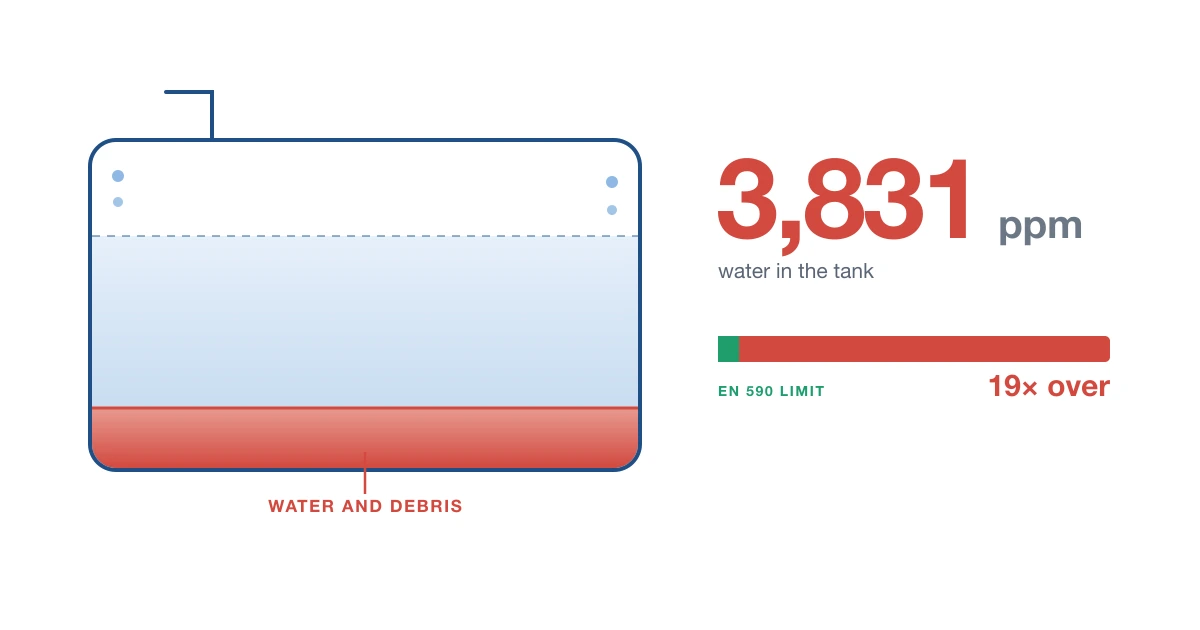
Free and dissolved water corrodes injection components and supports microbial growth. It is the contaminant most often present and least often measured.
A worn injector sprays differently
Injection is about pattern and timing, not just volume. As the nozzle wears, atomization degrades, and fuel that does not burn cleanly leaves the cylinder as something other than power.
The filters absorb the difference
Onboard filters do the work the fuel supply did not. They load faster, get changed more often, and that cost is usually filed under consumables rather than fuel quality.
A dockside crane, measured before and after
A deep-water cargo terminal in the UK runs Gottwald Terex dockside cranes rated at 125 tonnes and driven by Cummins diesel engines that generate both electrical power and hydraulic pressure. Fuel cleanliness in the crane tanks had reached a level the team considered critical for injector and pump reliability.
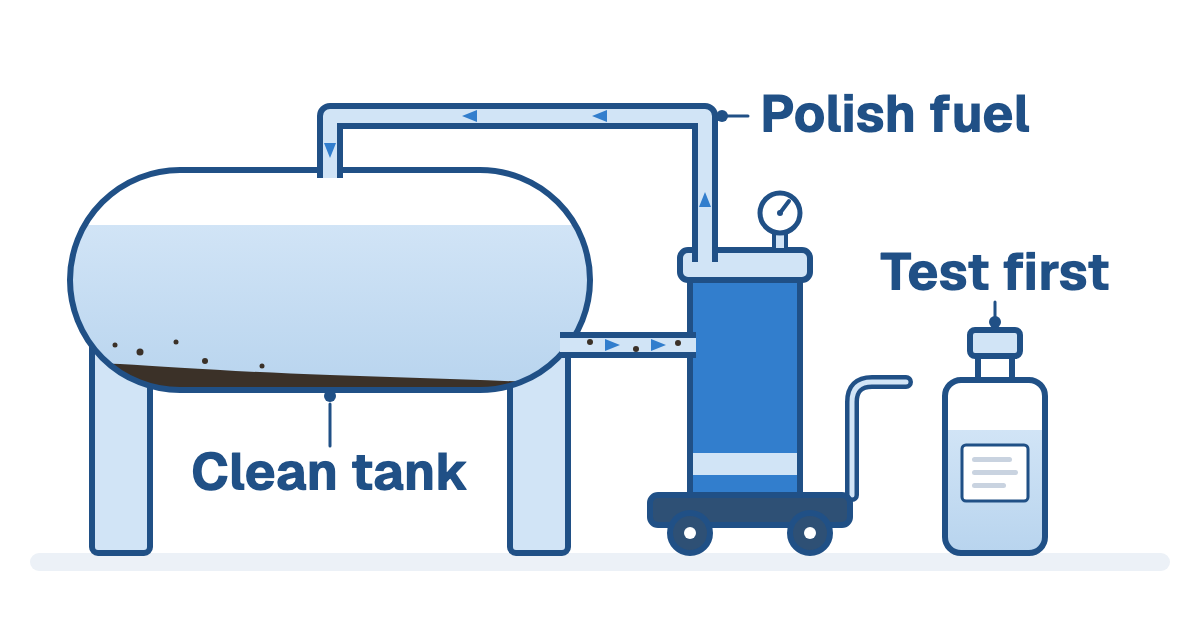
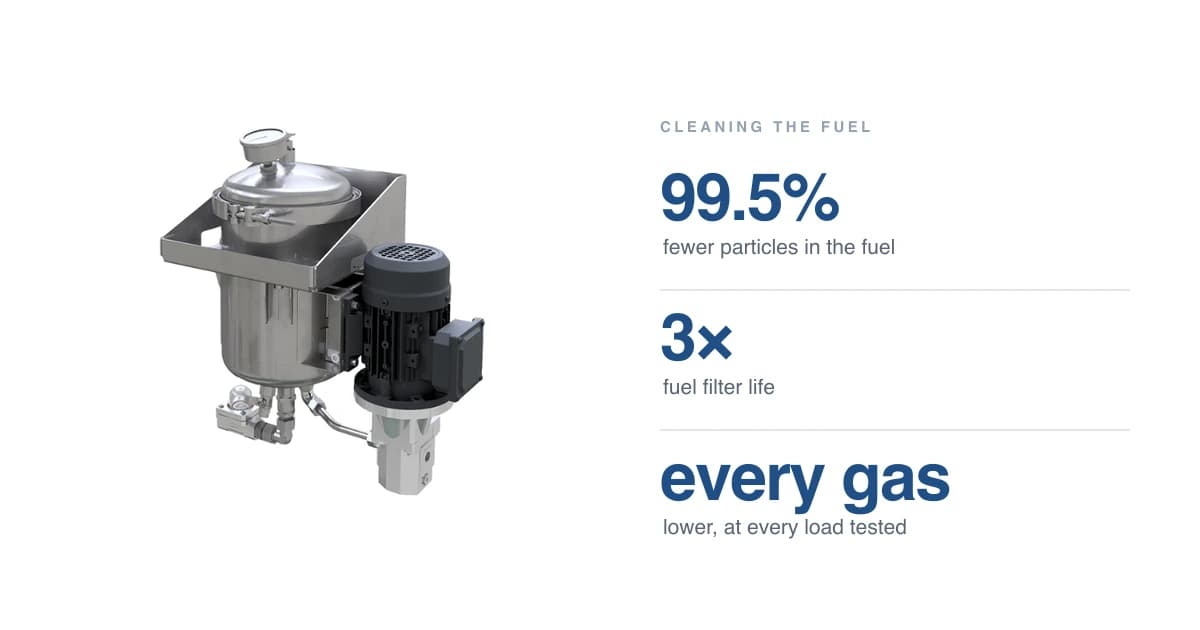
An offline conditioning unit was fitted to the main fuel tank of one crane, removing particulate, water, varnish and salts down to 0.1 micron, with an inline particle counter reporting ISO 4406 cleanliness continuously.
On fuel cleanliness the result was unambiguous. Particle counts fell by 99.5% above 4 microns, 99.7% above 6 microns and 99.9% above 14 microns, taking the fuel well inside ISO 4406 limits.
Then the exhaust measurements, reported as the percentage reduction in each gas:
Gas
Idle
Full load
Load + boom
NO₂
−45.3%
−41.4%
−72.4%
NO
−50.0%
−20.0%
−60.0%
SO₂
−15.7%
−9.6%
−44.7%
NOx
−8.3%
−9.6%
−44.7%
CO
−33.1%
−6.7%
−26.7%
Every gas fell at every test point, which is the headline. The spread is a more useful finding. The largest reductions came under full load with boom movement, the hardest duty tested, where nitrogen dioxide fell 72.4%. Under steady full load the same gas fell 41.4%, and carbon monoxide moved only 6.7%. A single percentage lifted out of that table would misrepresent it.
The operator also reported fuel filter life extended 3x, and less crane downtime. The filter figure is the kind of number an operations team notices monthly, and it arrives without any change to the maintenance routine beyond keeping the fuel clean.
What this proves, and what it does not
This is one engine, on one machine, in one trial. It shows that on that crane, conditioning the fuel moved the exhaust measurably in the right direction across every gas and every load tested. That is a real result, obtained carefully.
It is not a coefficient you can apply to your fleet. The size of any improvement depends on how dirty the fuel was to begin with, the condition and hours of the engine, the duty cycle, the fuel specification and the emissions control already fitted. An engine burning clean fuel through healthy injectors has little room to improve. The gain lives in the gap between where a machine is and where it should be, and only measurement tells you how wide that gap is.
What this means for fleets in Egypt or Saudi Arabia
The equipment described here is common across both markets. Port and terminal handling at Alexandria, Damietta, Port Said, Sokhna, Jeddah and Dammam runs the same class of diesel-driven cranes and handlers. Construction, quarrying and mining fleets run engines under sustained load in conditions where airborne dust reaches storage tanks, fill points and vents readily.
Emissions requirements differ by jurisdiction and by site, and some terminals answer to their own operators or customers rather than to national rules, so treat the compliance angle as a local question. The injector protection, filter life and combustion arguments do not depend on regulation at all.
Where to start
- Measure the fuel at the point of use. Not at delivery. A cleanliness code and water content drawn from the machine tank tells you what the injectors are actually being fed.
- Pull your filter change records. Filter interval is the cheapest proxy you already own for fuel quality. If elements are being changed early across a fleet, the fuel is telling you something before any laboratory does.
- Pick one machine and condition its fuel. A single unit with offline filtration, run alongside the rest of the fleet, gives a comparison that a specification sheet cannot. That is what the terminal above did before committing further.
- Decide what you are buying. Injector protection, filter consumption, uptime and combustion are four separate benefits with four different owners in most organizations. The case is usually stronger assembled than argued one line at a time.
NATCOM supplies the range behind that, from handheld cleanliness measurement to offline units on individual machines and bulk transfer filtration for storage and dispensing, through our fuel filtration systems. For on-site assessment and treatment, review the diesel fuel polishing service. If your interest is stored fuel that sits still rather than fuel being burned, the companion piece on standby generator fuel covers that case.
The exhaust is downstream of the tank
Fuel quality is normally justified as insurance against a repair bill. This trial suggests it also belongs in the conversation about how a machine performs while it is working, which is a different argument with a different audience inside the same company.
You will not know which of those arguments applies to your fleet until somebody measures the fuel in a machine tank. That is an afternoon, and it is the step that decides whether any of the rest is worth doing.
Bring a fuel sample result and your filter change records, and the rest of the conversation gets much shorter.

Frequently asked questions
In the trial described here, exhaust gas concentrations fell at every test point after the fuel was conditioned, with reductions ranging from about 7% to about 72% depending on the gas and the load. That is one engine on one machine, measured before and after with a calibrated analyzer. It demonstrates the effect on that unit rather than establishing a figure you should expect on yours, because the result depends on the starting condition of both the fuel and the engine.
High-pressure injection depends on nozzle geometry that is measured in microns. Abrasive particles and water degrade those surfaces, and a worn nozzle atomizes fuel less effectively. Poorer atomization means less complete combustion, and what does not burn cleanly leaves through the exhaust. Protecting the injection system is therefore also a combustion-quality decision, not only a reliability one.
ISO 4406 reports particle counts in three size bands, and the World Wide Fuel Charter sets 18/16/13 as the cleanliness standard for diesel at the filling-station nozzle. Engine manufacturers increasingly ask for that level or better at the injector. Fuel frequently arrives dirtier than the standard and gets dirtier in storage, which is why the level at the point of use is the one that matters.
It should, because onboard filters stop absorbing contamination that offline filtration has already removed. The operator in this trial reported filter life extended three-fold. Treat that as one site's experience: the gain depends entirely on how dirty the fuel was to begin with.
The equipment is similar but the problem is not. Standby tanks are about fuel that degrades while sitting still, and the question is whether the engine will carry the load when it is finally called. Working equipment burns through its fuel continuously, so the concern is what contamination does to the injection system, the filters and the combustion while the machine is earning.
The mechanism does not change by geography, and the exposure is arguably higher. Port terminals, construction, quarrying and mining across both markets run diesel equipment under sustained load in dusty conditions, where airborne contamination reaches storage and fill points readily. Emissions rules differ by jurisdiction and site, so treat the compliance angle as local, but the injector, filter and combustion arguments hold everywhere.