Every month someone walks to the standby generator, starts it, watches it run for a few minutes, signs the log and leaves. The test passes. It passes the month after that, and the month after that.
That test proves the battery holds charge, the starter turns, the controls respond and the engine fires. But it says nothing about the fuel that engine will have to burn for twelve hours without a break when the grid actually goes down.
Read the test log alongside the fuel records. When was the tank last sampled, where was the sample taken, and did the analysis include water and particle contamination? A record of successful starts answers a different question from a fuel-condition report. If that report is missing, the site has an unanswered readiness question even when every scheduled engine test has been completed.
The investigation should include the tank supplying the engine and its delivery, inspection and cleaning history. Fresh deliveries and short test runs do not establish the condition of fuel that remains in storage. Sampling provides a starting measurement, and follow-up checks show whether the condition is stable or needs attention. To choose those checks sensibly, first consider how water, particles and degradation products can accumulate during the long periods between demands on the generator.
Why fuel that sits still gets worse
Nothing dramatic has to happen for stored diesel to fall out of specification. The tank does most of the work on its own.
The tank breathes
Air is drawn in as the fuel cools and contracts, then pushed out as it warms and expands. Every cycle carries in humid air and airborne dirt.
Water collects and stays
Moisture condenses on the tank wall above the fuel line. Diesel is hygroscopic, so it holds what it picks up, and the rest settles at the bottom.
Nothing turns the fuel over
A generator that runs continuously refreshes its own fuel. A generator that waits does not, so contamination accumulates instead of passing through.
The damage lands downstream
Water corrodes injection components and supports microbial growth. Fuel that looks acceptable in a sight glass can still fail a laboratory test.
Why the monthly test run does not catch it
Test runs on standby sets are usually short, and often kept short to stay inside local emissions rules. That makes the test convenient and safe. But it also makes it blind to fuel condition.
- A short run burns a small fraction of the tank, so the stored fuel is never really turned over.
- The bottom of the tank stays undisturbed, and that is exactly where water and heavy debris sit.
- A lightly loaded run does not stress the injection system the way a sustained outage does.
- Nothing in the procedure produces a cleanliness or water figure that can be trended.
So the generator passes, and it keeps passing, right until the day it has to work for twelve hours instead of twelve minutes and draw further down the tank than it ever has before. The monthly test is a sensible procedure. But does it answer the right question the site needs answered?
What clean fuel means as a number
Fuel cleanliness has a measurement, which is what turns this from an argument into evidence a team can act on.
ISO 4406 reports three range numbers, one each for the count of particles above 4, 6 and 14 microns in a milliliter of fluid. Lower is cleaner. Each step in a range number represents roughly a doubling of particle count, so a code several steps higher is not marginally dirtier, it is dirtier by orders of magnitude.
18/16/13 is the cleanliness standard set by the World Wide Fuel Charter for diesel at the filling-station nozzle, and it is the benchmark used in the field documentation referenced below. EN 590 covers the fuel specification itself, including a target below 200 ppm dissolved water.
If nobody at the site can state the current cleanliness code and water content of the standby tank, that absence is itself the finding.
What one data center found six days before it needed both generators
A UK managed-services provider runs a central data center hosting regional databases for multinational clients. The site takes grid power, with two diesel standby generators covering mains failure and planned maintenance, each fed from a 12,000-liter tank.
The plan was to replace the grid transformers over a 12-hour weekend window, with both standby generators carrying the entire load in the meantime. The fuel had been largely static, and the monthly test runs were kept short to comply with emissions regulations, so its true condition had never been established. Before the window, the fuel was flagged as a risk and analysis was recommended. Samples from both tanks went to an independent laboratory.
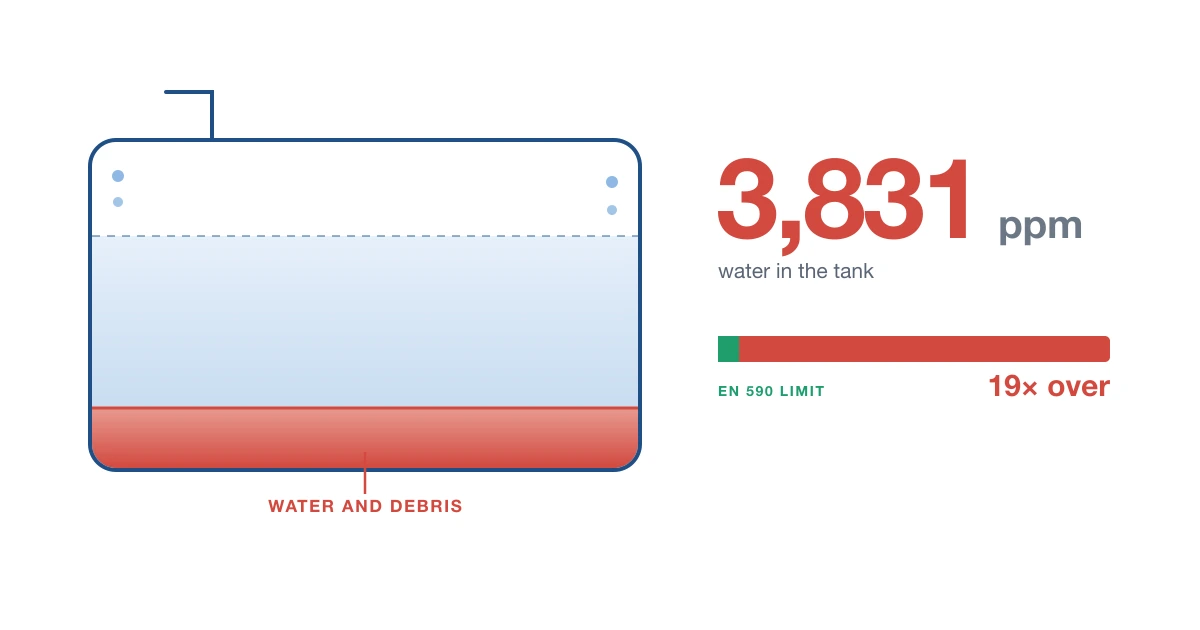
Every key measurement failed against the target specification.
Measure
Before
After six days
Water content
EN 590 target under 200 ppm
3,831 ppm
18 ppm
ISO 4406 cleanliness code
Target 18/16/13
23/23/22
15/13/10
Particles per mL above 4 µm
2,500 maximum
59,969
184
Particles per mL above 6 µm
640 maximum
49,597
72
Particles per mL above 14 µm
80 maximum
24,768
10
The count of particles above 14 microns, the size range that does the damage in a high-pressure injection system, came back more than 300 times the stated maximum. The supplier's assessment was that if the grid had dropped and the generators had been called on, they would likely have run for less than an hour. That is the supplier's professional judgment rather than a measured result, and it should be read that way. It was enough for the client to postpone the transformer work rather than find out.
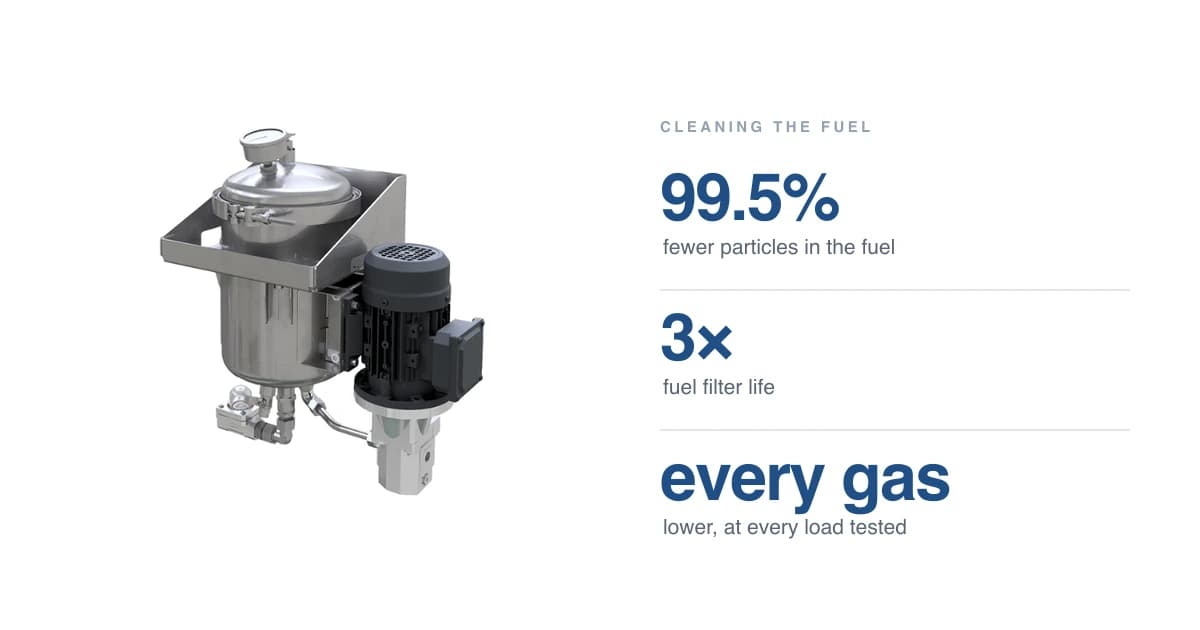
A single offline filtration cartridge was installed as a mobile unit, running a side stream on the tank. Six days later the same fuel measured 18 ppm water and an ISO 4406 code of 15/13/10, cleaner than the 18/16/13 target rather than merely inside it. No fuel was replaced. The transformer maintenance went ahead with both generators available, and the client revised its monthly test procedure afterwards. That documented outcome belongs to that site and its conditions. It is not a typical result.
What this means for a data center in Egypt or Saudi Arabia
That case was recorded in the United Kingdom, which raises the obvious question for an operator running standby power in Cairo, Alexandria, Riyadh, Jeddah or Dammam. The specification does not move. ISO 4406 and EN 590 mean the same thing in Egypt and Saudi Arabia as they do anywhere else, so a tank that fails in one climate fails in another.
What does change is how hard the mechanism is driven. Tank breathing is powered by the temperature difference between day and night, and that swing is large across Egypt and the Gulf for most of the year. Coastal sites add humidity to the air being drawn in, which is the moisture that ends up condensing on the tank wall. Inland and desert sites add airborne dust around vents and fill points. None of that is measured in the case above. It simply means the conditions that fill a tank with water and debris are present, and a site cannot assume a European or North American service interval transfers unchanged.
The second regional difference is duty. If your data center in Egypt or Saudi Arabia is designed to ride out a long interruption rather than a brief one, the generators will draw further down the tank than any monthly test has ever taken them. The longer the outage the site is built to cover, the more of the tank gets used, and the more the settled layer at the bottom matters.
Fresh fuel does not fix a dirty tank
The instinct, once someone says the diesel is contaminated, is to top the tank up with clean fuel or swap the charge out entirely.
A field trial at PT Petrolog Indah in Indonesia shows why that reasoning fails. A DX1525 unit ran on a 300-liter diesel tank with a particle counter logging the cleanliness code for 64 hours. The fuel started at 19/18/17 and finished at 13/12/7. The instructive part is the middle of the trial rather than the endpoint. At the 8-hour mark the code rose to 20/20/20 after the vehicle crossed rough ground and stirred settled debris back into suspension. At 20 hours it reached 24/23/22 immediately after 137 liters of fresh diesel were added.
Adding fresh diesel made the recorded cleanliness code worse, from 20/19/19 to 24/23/22, before filtration brought it back to 18/18/17 within ten hours.
New fuel arrives carrying its own particle load, and the act of filling disturbs everything that had settled. Buying clean fuel does not produce a clean tank.
A decision path for your own standby fuel
- Establish the baseline. Draw a representative sample and obtain a cleanliness code and water content. A laboratory result gives defensible paperwork. A handheld cleanliness check gives a fast on-site reading when several sites need screening. One sample is a snapshot rather than a clearance, so record the conditions and plan to repeat it.
- Understand what the result means for the duty. Compare the code and water content against the fuel specification and the engine manufacturer's requirements, then against the length of outage the site is expected to cover. A marginal result on a two-hour duty is a different decision from the same result on a twelve-hour duty.
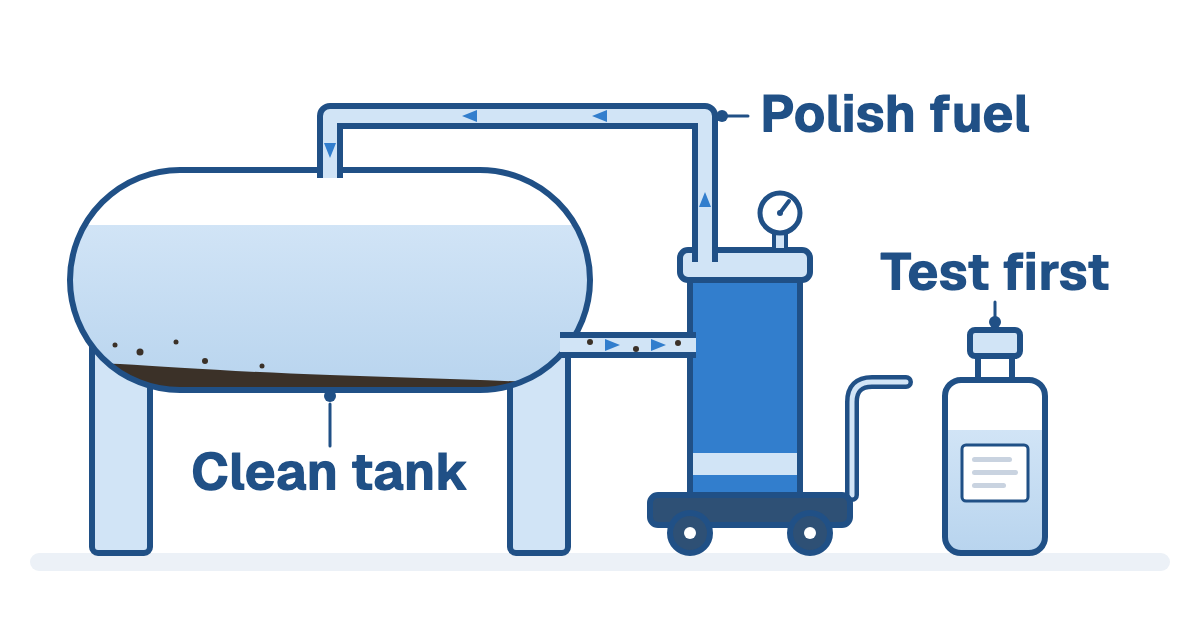
- Recover the fuel in place if it fails. Offline filtration circulates the charge through fine media on a side stream while the tank stays in service, removing particulate and taking out water. Sizing follows tank volume and how quickly the result is needed, from a single mobile cartridge on one tank up to bulk skids for transfer duties.
- Close the loop in the procedure. Recovery is a one-off event. Staying clean is a standing arrangement: permanent or bypass filtration to handle the ingress that tank breathing causes, and fuel condition added to the standby test regime so the next result is trended rather than discovered.
NATCOM delivers that chain through its diesel fuel polishing service, using fuel filtration systems from Delta-Xero and Filtertechnik. The range covers handheld cleanliness measurement, mobile and permanent offline filtration, water removal and bulk transfer skids. Measurement comes first because it tells you which of the rest you actually need.
The cheapest step is the one nobody takes
One sample answers the question
A cleanliness code and a water figure cost a fraction of a single hour of unplanned downtime, and most sites have never produced either for their standby tank.
The fix runs while the tank stays in service
Offline filtration works on a side stream without draining the tank, which is why fuel condition can be corrected inside a maintenance plan rather than during an emergency.
Find out when anyone last tested the fuel in your standby tank, as opposed to starting the engine. If you run a data center, hospital or telecom site in Egypt or Saudi Arabia and nobody can answer that, you are not unusual, and it is correctable well before the grid gives you a reason to care.

Frequently asked questions
There is no universal shelf life, and a single stated figure should be treated with caution. Storage behavior depends on tank design and venting, temperature swings, water ingress, how often the fuel turns over, and the condition of the fuel on delivery. Because those variables differ by site, the reliable answer comes from sampling and trending your own tank rather than from a calendar rule.
Water should be judged against the fuel specification and the equipment manufacturer's requirements rather than a single universal threshold. The field trial report cites EN 590 with a target below 200 ppm dissolved water. In the UK data center case described here, the stored fuel measured 3,831 ppm before treatment and 18 ppm after six days of offline filtration.
Fuel polishing circulates stored fuel through filtration media on a side stream, removing particles and absorbing or separating water while the tank stays in service. It is the same principle as offline kidney-loop oil filtration applied to diesel. It addresses particulate and water contamination. It does not reverse chemical degradation of the fuel itself.
No single interval suits every site. The practical starting point is one baseline sample that establishes the current cleanliness code and water content, then a repeat interval set from how quickly that result moves and how critical the standby duty is. A site with no baseline has no basis for choosing an interval at all.
Sometimes, but it is expensive, it takes the asset out of service, and it does not address the tank. Fresh fuel arrives with its own particle load and the act of filling agitates settled contamination. In the Indonesian field trial referenced here, the recorded cleanliness code moved from 20/19/19 to 24/23/22 immediately after 137 liters of fresh diesel were added.
The degradation mechanism is the same everywhere: the tank draws in air as the fuel cools and contracts, and moisture and dust come in with it. Large day-to-night temperature swings drive that exchange harder, coastal humidity around Alexandria, Jeddah or Dammam raises the moisture in the air being drawn in, and desert dust adds particulate around vents and fill points. Those conditions make the case for sampling stronger, but they are not a substitute for it. Only a fuel analysis tells you the state of your own tank.
It means the starting system, controls and engine responded on the day. It does not confirm that the stored fuel will support hours of sustained load, because a short test run neither draws the tank down significantly nor disturbs the settled layer at the bottom. Fuel condition needs its own evidence.