A diesel delivery is due, and the receiving tank already contains fuel. Before the two are mixed, what has the site actually checked?
Useful diesel delivery checks cover the product arriving, the tank receiving it and the route between them. Agree what evidence supports receipt, record the tank's starting condition, and confirm whether the transfer passes through filtration selected for that duty. An existing fuel-polishing system does not automatically answer those questions.
The distinction matters when a problem appears after a refill. Without a record of the starting conditions, the maintenance team may struggle to separate an incoming-fuel concern from contamination already present in storage or introduced through the transfer equipment.
Agree the receiving evidence before the delivery
Start with the fuel ordered and the equipment that will use it. Ask the supplier what documentation identifies the delivered product and what condition evidence accompanies it. Match the delivery information to the intended tank and fuel requirement.
If a quality report is supplied, read what it represents. Which product or batch does it identify? Where and when was the sample taken? Which properties were tested? A report about fuel at an earlier point in the supply route is useful evidence about that sample. It does not describe everything that happens later.
Set out who reviews an unexpected finding and what happens while it is unresolved. That discussion belongs before a vehicle is waiting at the fill point. Avoid leaving the decision to whoever happens to be available during unloading.
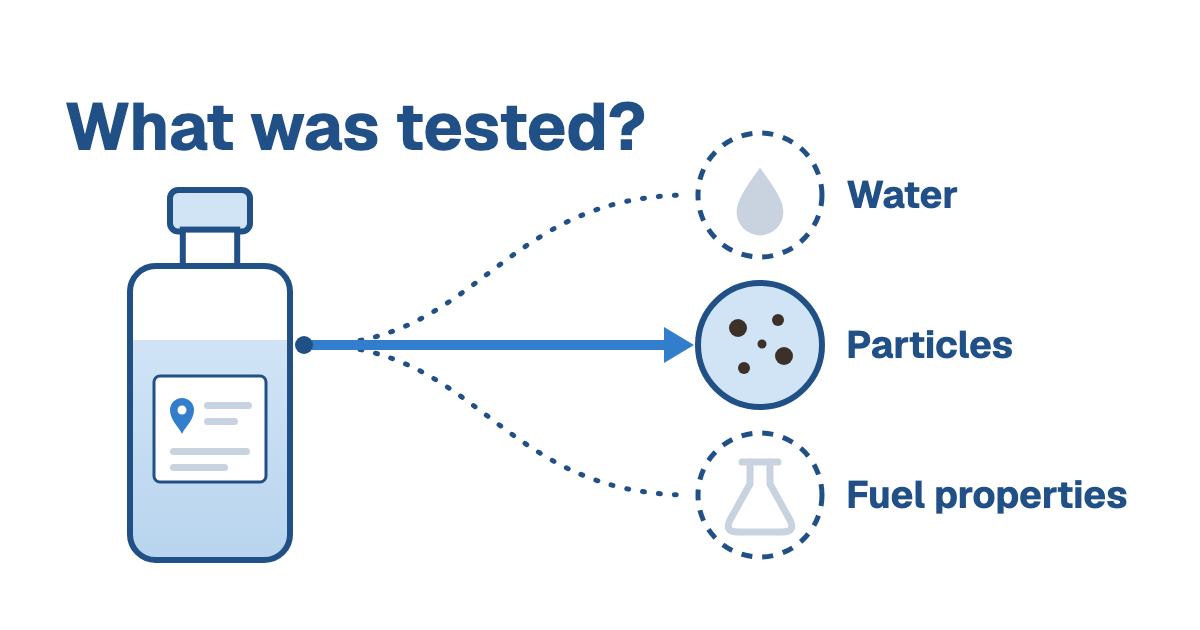
The test package should follow the concern. Particle contamination, water and wider fuel properties need different evidence. Our guide to which diesel fuel tests to request explains that choice in more detail.
Establish what is already in the tank
A new delivery enters an existing storage system. Check the available tank-condition records, recent water findings, previous treatment and unresolved maintenance issues before assuming that fresh fuel settles an old problem.
Caterpillar's bulk-fluid guidance calls for moisture, debris and sediment to be removed before adding fluid. For the receiving team, the practical question is whether a known condition has been addressed and documented, or simply carried into the next delivery.
Keep pre-delivery findings separate from later observations. A record of water already present helps the team investigate subsequent results without assigning the cause by guesswork. Where an issue remains, the responsible site team should decide how it affects receipt under the site's procedures.
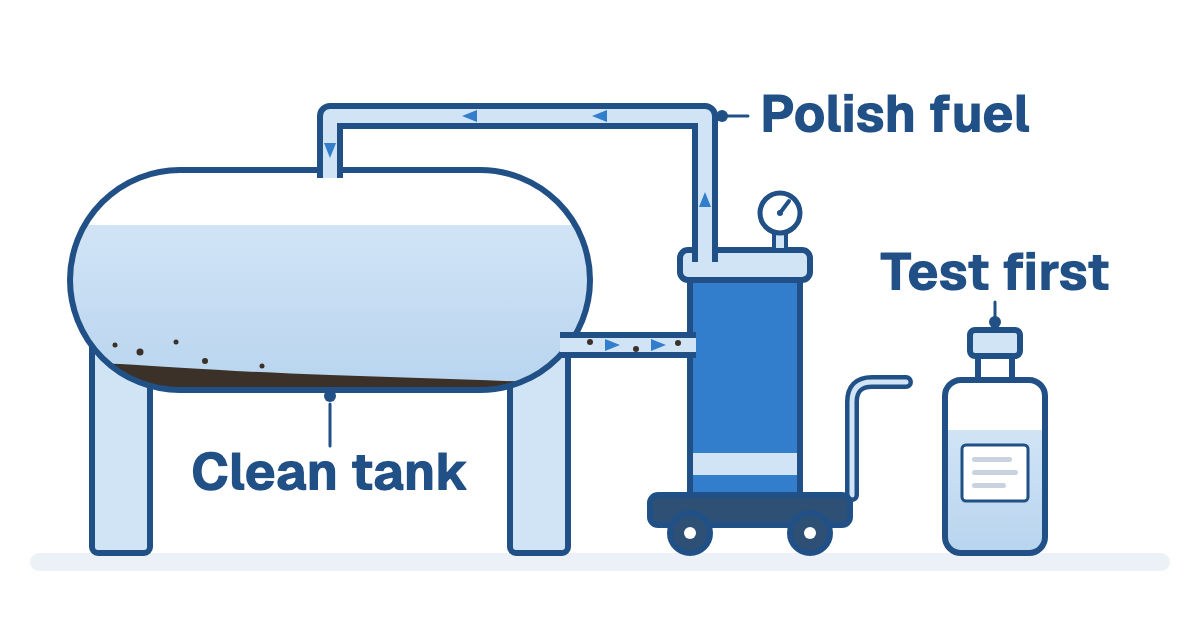
If the existing tank needs work, use the evidence to choose between polishing, tank cleaning or replacement. Buying replacement diesel and preparing the tank are separate decisions.
Include the hose, pump and fill connection
Fuel passes through more than the delivery vehicle and the tank. Cummins identifies storage and transfer as contamination opportunities, including the effect of hoses, connections, pumps and delivery equipment.
Include that route in the receiving review. Confirm that the equipment is suitable for diesel, that maintenance covers it, and that damaged components or exposed connections receive attention. A worn seal or poorly maintained hose can undermine the effort spent checking the product itself.
This review should produce clear responsibilities. Who owns the transfer equipment, who records a defect, and who decides whether it affects the planned delivery? Those answers are more useful than a checklist tick saying only that a filter is fitted.
Separate incoming filtration from stored-fuel polishing
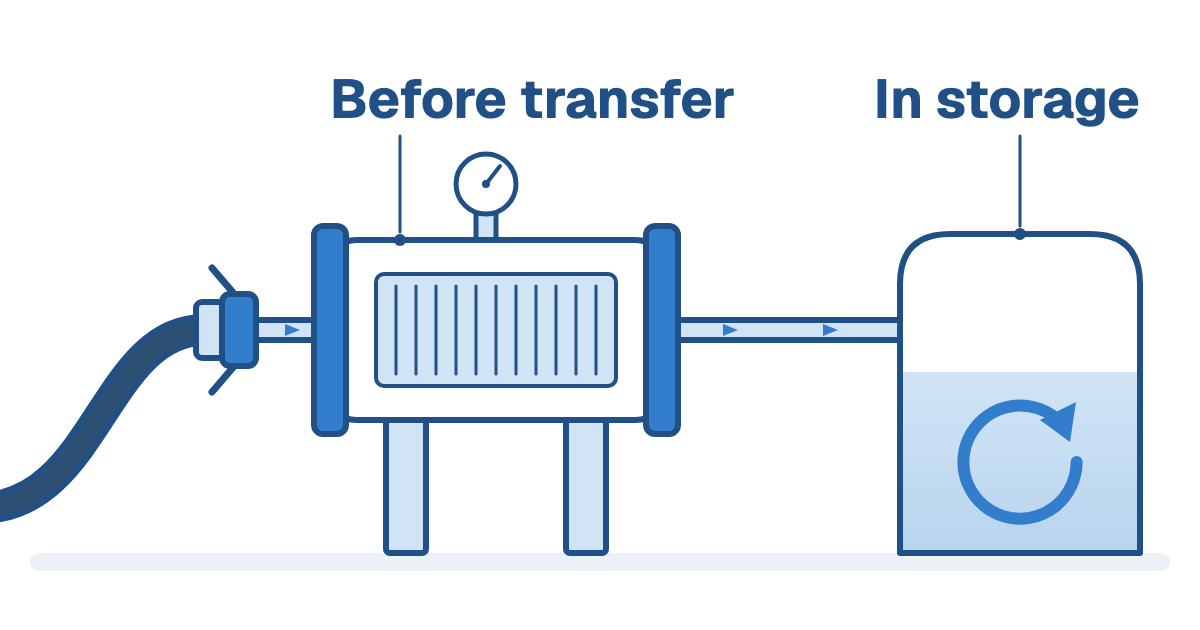
An inlet filter treats fuel on its way into storage. A polishing loop withdraws stored fuel, treats it and returns it to the tank. Filtration at the dispensing point treats fuel as it leaves for downstream equipment.
These duties can complement one another. Their positions determine what they can address.
| Treatment point | The question it answers |
|---|---|
| Incoming transfer | What contaminants can this assembly remove at the required delivery flow before fuel enters storage? |
| Tank recirculation | What condition can treatment establish in the stored fuel, and how will the result be checked? |
| Dispensing or equipment feed | What protection is provided on the final route out of storage? |
Trace the actual pipework before crediting an existing system with all three jobs. A small unit connected from the tank back to the tank may never see the delivery stream as it arrives. Equally, an inlet filter does not remove material that was already inside the receiving tank.
Specify the transfer duty before choosing the filter
Filtertechnik's First Aid for Fuels brochure makes a useful distinction. Its bulk-diesel skids combine particulate filtration with coalescing, which brings small water droplets together for separation, and describe transfer applications. Its filtration cart covers dispensing, transfer and polishing duties.
That is evidence that treatment can be arranged around different points in the fuel route. It is not a reason to select any unit bearing the word "fuel" for every job.
Give the supplier the required transfer flow, fuel type, temperature range and permitted pressure loss. Pressure loss is the resistance created as fuel crosses the assembly. These inputs help determine whether the proposed equipment suits the transfer, rather than only a slower recirculation duty.
A micron rating alone leaves too much unanswered. Ask which contaminants the proposed media address, how the water-removal stage suits the fuel, and what evidence supports performance at the intended operating conditions. Include the monitoring and element-service requirements in the review.
Keep the verification question attached to the equipment question. Filtertechnik's documented field workflow pairs condition checks with selected polishing media, retesting and retained data. It does not provide a measured customer result or certify every fuel property. The same discipline is useful at receipt: decide what will be measured before treating the presence of filtration as proof of a result.
Make samples traceable to the decision
A sample identified only as "diesel tank" can leave the next person unable to interpret the result. Record the tank or delivery reference, sampling point, time, and whether sampling happened before or after transfer or filtration.
ASTM's manual-sampling guidance explains that a spot sample represents one particular point. An inlet sample, a tank-bottom sample and a filtered-outlet sample answer different questions.
Agree sampling and handling with the responsible technical team or laboratory. To distinguish incoming contamination from existing tank contamination, plan evidence for both questions.
Continue the review with comparable evidence and the acceptance basis agreed for the intended equipment. A satisfactory outlet result is one part of that record.
A short review for the next delivery
Use this checklist to prepare the conversation between maintenance, procurement and the fuel supplier. It is a suggested information list, to fit the site's receiving procedure.
| Review item | Information to have ready |
|---|---|
| Product and destination | Ordered fuel, delivery reference and receiving-tank identity |
| Starting tank condition | Available reports, water findings, treatment history and unresolved maintenance |
| Transfer route | Responsible equipment owner, actual filtration position and relevant defects |
| Filtration duty | Fuel, delivery flow, operating conditions and intended contaminant removal |
| Evidence and follow-up | Agreed samples or checks, reviewer, record location and action for unexpected findings |
The resulting record should let someone reconstruct the decision later. Keep the delivery information with the relevant tank observations and follow-up results so the next investigation starts with evidence.
For sites receiving diesel into generator tanks or fleet storage in Egypt and Saudi Arabia, the useful starting point is the same: define the receiving decision around the actual installation. The applicable fuel requirements, operating procedures and equipment criteria still need site-specific confirmation.
Review the route before the next delivery
Send NATCOM the tank arrangement, delivery volume and flow, fuel type, existing filters and available condition reports. The discussion can separate receiving filtration from stored-fuel treatment and identify the information needed for system selection.
Review the fuel-filtration systems guide or discuss incoming diesel filtration with the team.

Frequently asked questions
Only if the installation routes that delivery through suitable treatment equipment. A separate tank-recirculation loop treats stored fuel and may not receive the incoming stream. Check the piping arrangement and rated duty before assuming it provides receiving filtration.
It is evidence about the product and sample identified in the report. Check its date, sampling point and test scope. The receiving tank, subsequent transfer and existing fuel need their own relevant evidence; the report cannot describe untested parts of that route.
Select it around the fuel, contamination, required transfer flow, equipment requirements and supported filter performance. Also establish the water-removal need and allowed pressure loss. A micron number by itself does not define the whole system or establish a universal acceptance limit.
No. A system selected for particles and water addresses its stated contaminant-removal duty. Wrong-product concerns or other fuel-property problems need assessment with the fuel supplier and technical team. Do not assume that cleaner appearance or a lower particle count restores every property required for use.