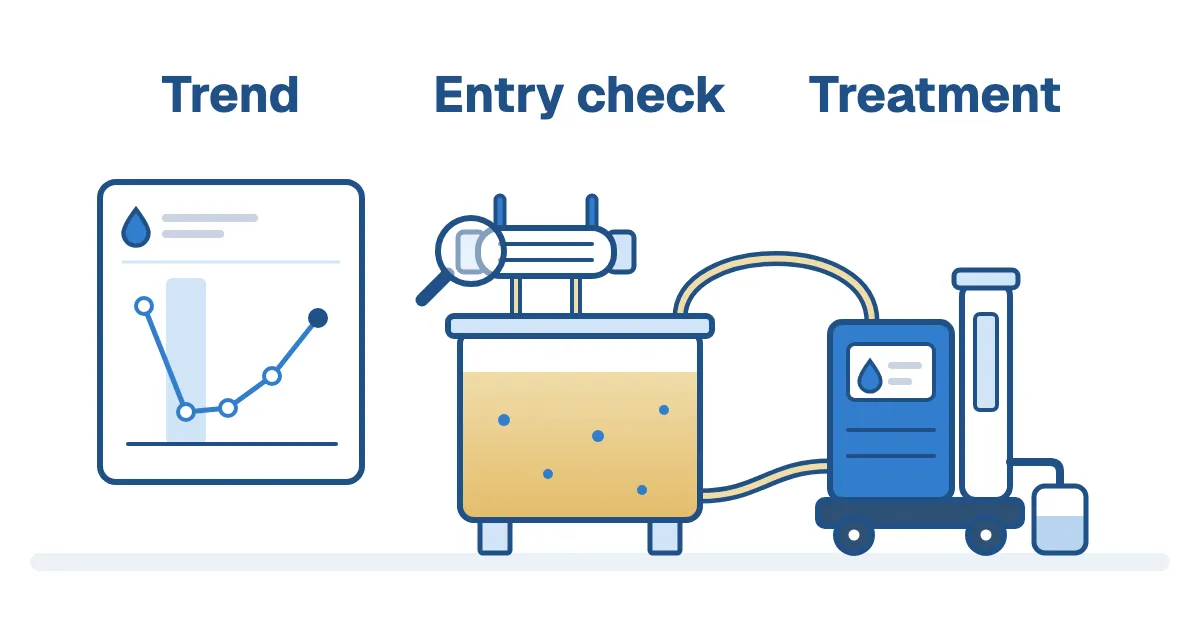
The oil was treated, the water result fell, and the next report is high again. Before booking the same cleanup, establish whether the comparison is valid and whether water is continuing to enter the system. A successful removal job can be followed by renewed contamination when the entry route remains unresolved.
There is another possibility. The results may describe different sampling points, temperatures or water measurements. Put those details beside the trend before deciding that the treatment failed or that a cooler must be leaking.
The next action should answer a specific question about the recurrence. Repeating treatment without that question can leave the team paying for cleanup while learning very little about why the problem returns.
Check whether the two results are comparable
Start with the method and units. Water concentration in parts per million and relative saturation describe different properties. Relative saturation expresses how close the oil is to holding all the water it can dissolve under those conditions. A percentage reading cannot be treated as the same result as a laboratory concentration.
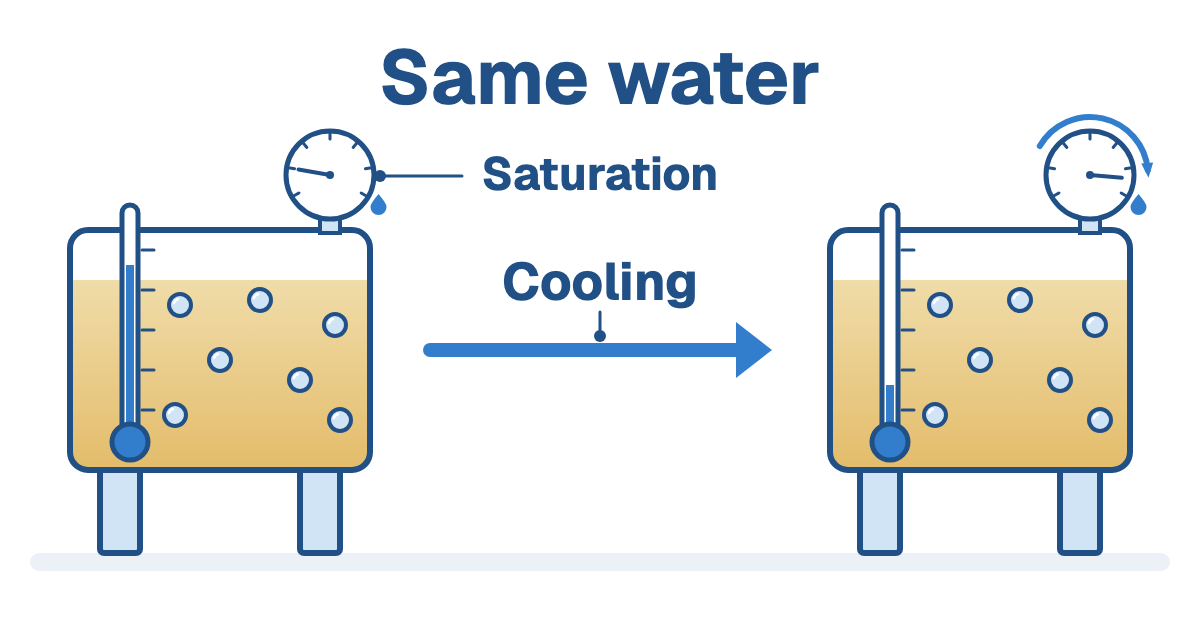
Temperature matters to that comparison. Pall's fluid-cleanliness guidance shows that cooling can cause free water to appear when the oil's ability to hold dissolved water falls. A change in visible condition or saturation therefore needs its temperature context. The water-in-oil guide explains the measurements in more detail.
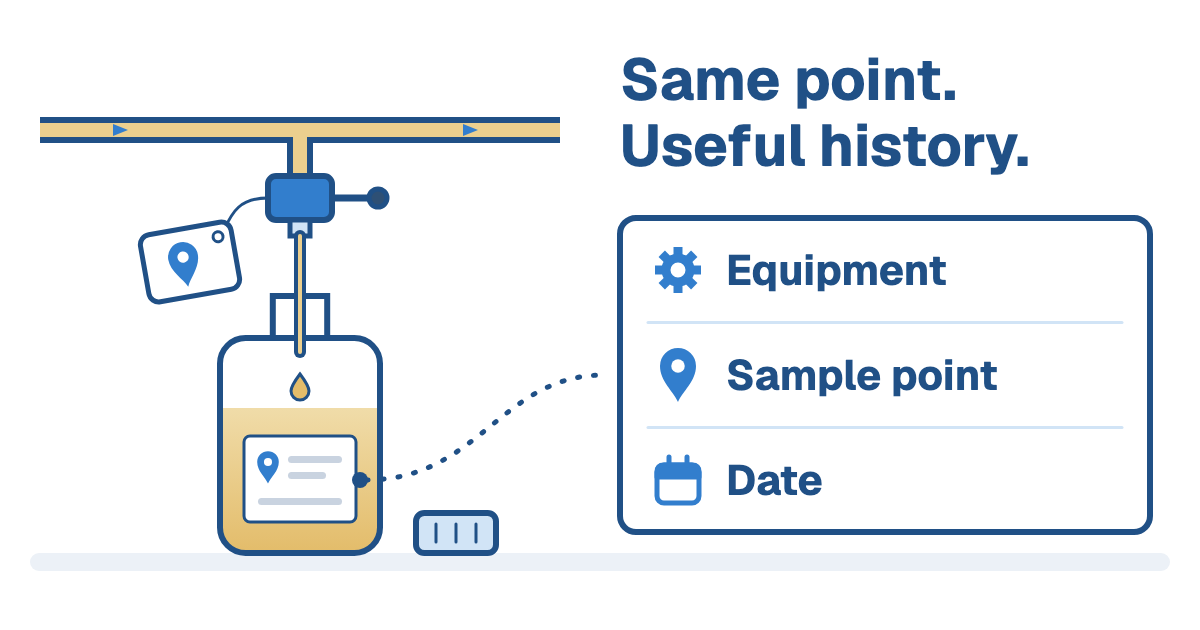
Record the sample location as well. A sample at the treatment outlet answers a different question from one taken in the operating reservoir. Keep the same representative sampling method for the trend, and retain any additional diagnostic samples under separate labels.
Investigate possible entry routes against the history
Pall identifies heat-exchanger leaks, seal leaks, condensation and inadequate reservoir covers among possible sources of water contamination. Use that list to plan an investigation around the actual system. It does not identify which route applies to your machine.
Suppose the increase appears after maintenance involving a cooler. That timing makes the cooler and the associated work worth examining, but it is not proof of an internal leak. Compare the operating and maintenance records with the sample trend, then agree a suitable inspection or test with the responsible engineering team.
If increases instead follow washdowns or outdoor exposure, examine the reservoir closure and other plausible access points. Record what the inspection found. A note that says water ingress suspected is much less useful at the next recurrence than a named component, an observed defect and a completed corrective action.
Separate removal capacity from source correction
A dehydration system removes water within its operating capability and application limits. It does not repair a seal, a damaged cover or a leaking heat exchanger. Continuing removal may help control contamination, but that is a different responsibility from stopping the source.
Ask the treatment supplier which water states the proposed method addresses, what inlet conditions it can handle and how performance will be verified. Also ask what happens if the rate of incoming contamination changes. Avoid treating a low outlet reading as evidence that the entire oil inventory has reached the same condition.
That distinction changes the work scope. One task may be to restore the oil condition. Another may be to locate and correct the source. Assign both explicitly so that a completed treatment report does not close an unfinished mechanical investigation.
What a documented cleanup result can tell you
In Filtertechnik's Commonwealth Steel account, the source reports water falling from 800 ppm to 50 ppm while the existing hydraulic oil was retained. It also describes continuous filtration after the initial cleanup. This is one documented customer outcome, not a universal dehydration target or a guarantee for another system.
The local source does not establish the contamination source or a long-term sampling history. It cannot demonstrate that the later filtration prevented water ingress. Its useful contribution is that water removal and ongoing contamination management can be separate stages of the work.
For your system, ask for the evidence needed to distinguish those stages. Retain the initial condition, treatment arrangement and final results, then continue the comparable operating trend. The steel hydraulic-oil account gives the documented case context.
Define what would close the investigation
Agree an oil-condition criterion suitable for the equipment and lubricant, with the relevant test method and sampling conditions. Separately define what evidence would show that the suspected entry route has been corrected. Do not borrow a water number from another customer's case as your own acceptance limit.
After the work, review the trend under representative operating conditions. A single satisfactory sample is a snapshot. It cannot establish that recurring contamination has been resolved across the machine's operating cycle.
Bring the water trend, treatment history and system information together before the next intervention. If the evidence shows continuing ingress, source correction belongs in the plan alongside cleanup. If it shows inconsistent measurements, first make the comparison reliable. Both routes produce a more useful decision than repeating the previous job without an explanation.

Adham Lotfy is an Account Manager for Oil & Fuel Care at NATCOM and a mechanical engineering graduate of the American University in Cairo. His background includes technical sales at Swagelok North Africa and industrial sales at Air Liquide.
Frequently asked questions
No. Continuing ingress, different sample locations or changes in measurement conditions may explain the recurrence. Review comparable results and the treatment scope before concluding that the equipment failed.
It can remove contamination within its capability, but it does not repair the entry route. Source correction and oil treatment need separate responsibilities and evidence.
Temperature changes can alter saturation and water state. Record temperature and use the appropriate concentration test when investigating whether the total water content increased.
Agree the criterion for the equipment, lubricant, operating conditions and test method. A result achieved in another customer account is not a universal acceptance limit.