The oil looks clear in the sight glass, but the laboratory report flags water. A portable instrument gives a percentage instead of parts per million. The team now has two readings and an equipment supplier offering dehydration. Which result should drive the decision?
Water in oil needs two questions answered. How much water is present, and how close is the oil to the point where it can no longer hold that water dissolved? Parts per million, usually shortened to ppm, describes concentration. Relative saturation describes proximity to that limit at the measurement temperature. Use the oil identity, both measurements where available and operating history to select treatment. Neither number alone chooses the machine.
Identify the fluid before removing its water
This guide concerns unwanted water in industrial lubricating and hydraulic oils. Confirm the exact product first. Some fire-resistant hydraulic fluids, including water-glycol fluids, deliberately contain water as part of their formulation. Removing it without the fluid manufacturer's guidance would address the wrong problem.
In oils where water is contamination, it can impair lubrication, promote corrosion and accelerate degradation. The practical consequence is a maintenance job that may extend beyond drying the oil. Include the lubricant's wider condition in the assessment before deciding to retain it or buy a replacement charge.
Clear oil can still contain water
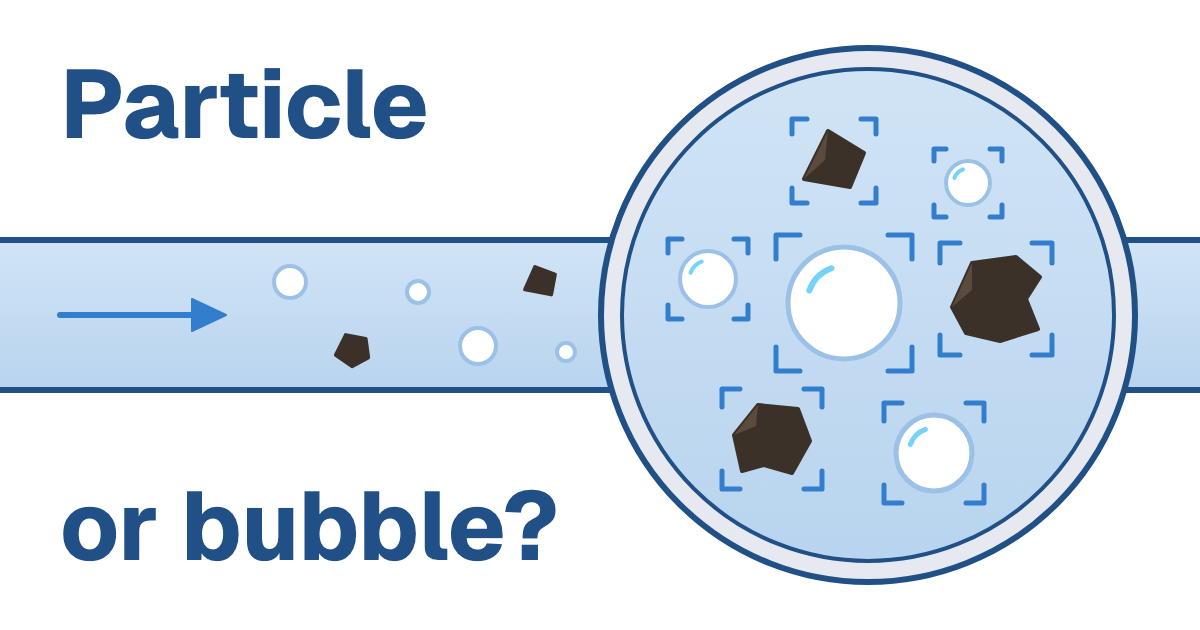
Water can be present in several forms, which helps explain why appearance is an unreliable acceptance test.
- Dissolved water is held within the oil without a separate visible water phase. The oil can look clear.
- Emulsified water consists of fine droplets dispersed in the oil. It can give the oil a cloudy or milky appearance.
- Free water has separated from the oil, often collecting at the bottom of a reservoir.
A sample from circulating oil and a sample taken to investigate water at the reservoir's low point answer different questions. Record the location and purpose of each sample. Ask the laboratory how to collect and prepare a representative sample for the requested measurement, especially when water has separated.
What ppm tells you, and what saturation adds
A water result in ppm reports a concentration. Where the laboratory reports by mass, 1 ppm is 1 milligram of water per kilogram of oil. Karl Fischer titration is a laboratory technique for measuring water, and ASTM D6304 is a method used for petroleum products and lubricating oils. Keep the method and reporting units with the result.
Relative saturation, written as %RS or sometimes %RH on oil instruments, describes how close the oil is to water saturation. At 100% saturation, the oil has reached its capacity to hold dissolved water under those conditions. Water activity expresses the same relative condition on a scale from zero to one. A reading of 0.5 water activity corresponds to 50% relative saturation; it does not mean the oil is 50% water.
These are different views of the water condition. Use a suitable laboratory result to quantify concentration and a compatible moisture sensor to follow changes in saturation. If an instrument displays calculated ppm, ask which oil-specific relationship it uses. Do not treat a percentage reading as a direct substitute for a laboratory ppm result.
Temperature can change the warning without adding water
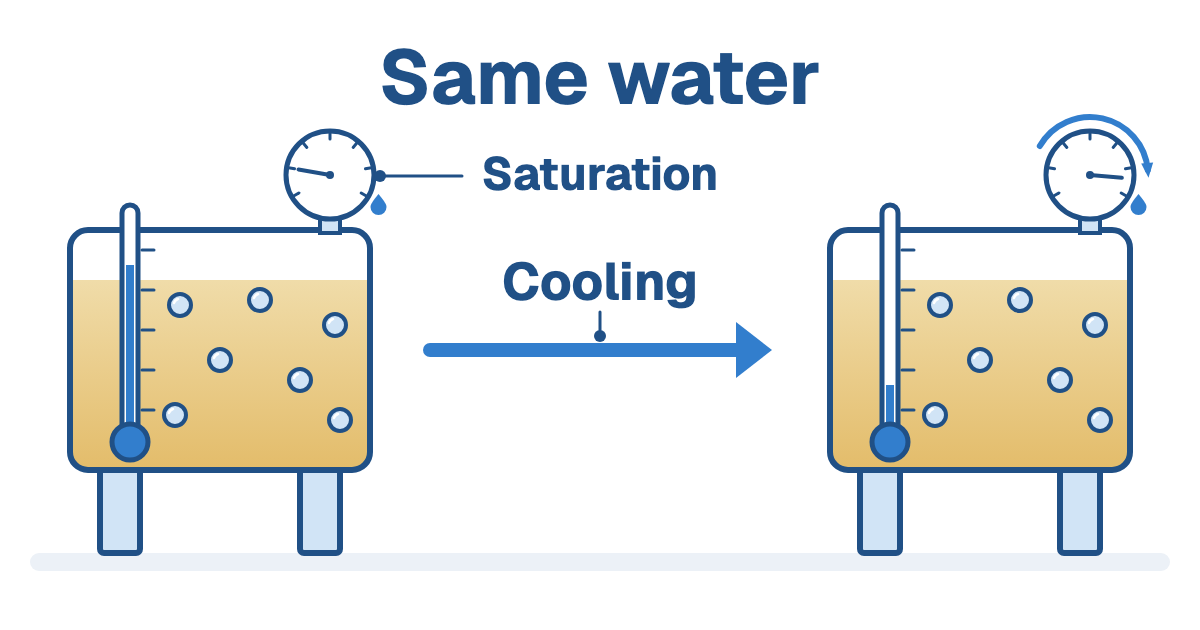
Oil's capacity to dissolve water depends on its formulation, condition and temperature. As oil cools, its capacity generally falls. The water concentration can remain unchanged while relative saturation rises. With enough cooling, water can separate even though no new water entered the system.
That matters when comparing a warm running system with a cold restart, or a live sensor with a bottle that has cooled before testing. Keep temperature alongside saturation readings. Compare the same measurement location under recorded conditions, and examine the coolest relevant operating state when setting the water-control plan.
Avoid a universal ppm-to-saturation conversion. The relationship needs the specific oil and temperature, and can change as the oil ages. Likewise, a water limit printed on a product brochure is not automatically the acceptance limit for your turbine, hydraulic system or gearbox. Agree that limit against the equipment and lubricant requirements.
Choose a removal method for the water that is present
First establish the fluid, water condition and required result. Then review viscosity at the treatment temperature, reservoir volume, access and whether water is still entering. Ask suppliers to identify what their proposed system removes and the conditions supporting that claim.
- Coalescing brings small water droplets together so they can separate. It addresses water present as droplets; confirm performance with the actual oil and its ability to separate from water.
- Water-absorbing media retains water in replaceable elements. Selection must cover water load, element capacity and the planned replacement interval.
- Vacuum dehydration exposes oil to reduced pressure to remove water, including dissolved water. Specify a compatible unit and an operating temperature suited to the lubricant.
The word dehydration does not identify the mechanism. For example, Filtertechnik's Neptune range uses water-absorbing media for free and entrained water, meaning droplets carried in the oil. It is not a vacuum system. NATCOM's oil dehydration service explains the assessment and selection process for a particular reservoir.
What one hydraulic oil cleanup actually achieved
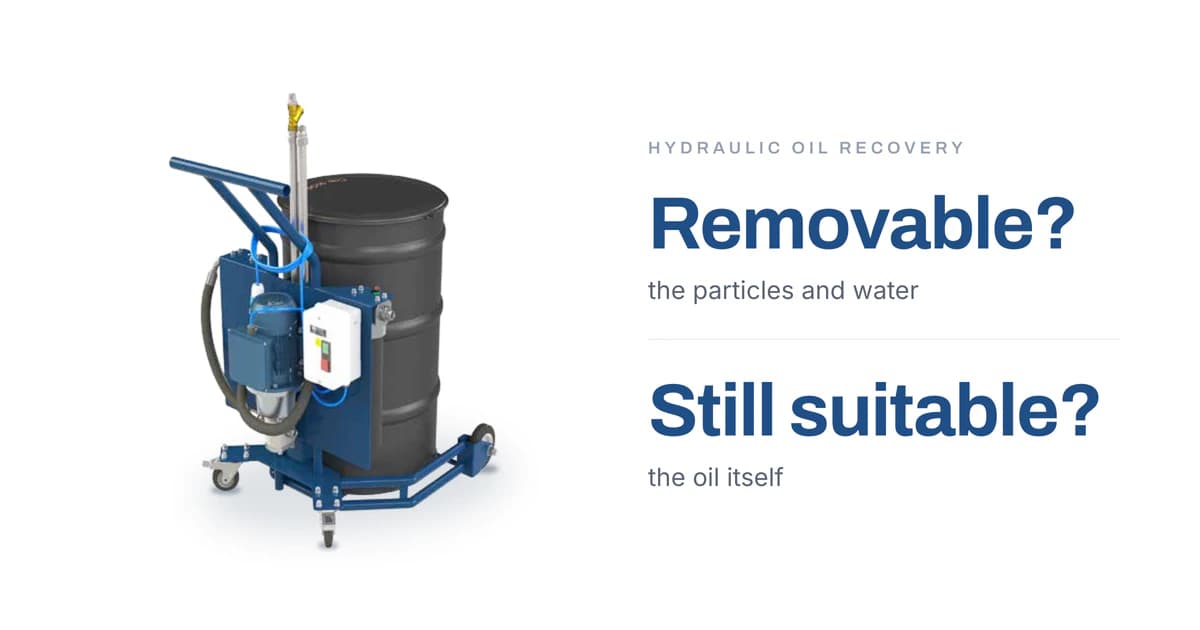
Filtertechnik, a NATCOM technology partner, documents a steel-plant hydraulic oil cleanup carried out by PT Kelmer. The system contained approximately 900 litres of ISO VG 32 oil. Water measured 800 ppm before treatment, while particle contamination measured ISO 4406 21/19/16.
Two portable HIPPO filter pots treated the oil through an external circulation loop. The source reports water falling to 50 ppm and particle cleanliness reaching ISO 13/12/8 after two days. The plant retained the existing oil. Read the documented hydraulic oil cleanup for the source context.
Those are results from one installation. They show that suitable treatment can reduce water and particles together. They do not establish a two-day treatment promise or a 50 ppm target for another system. That decision still needs the other oil's condition, water load and operating requirements.
Agree how you will know the treatment worked
Define completion before the treatment starts. A lower reading at the unit outlet is useful process information, but the acceptance question concerns the oil the machine will operate with. Use representative system measurements and a follow-up plan to establish whether the improvement holds.
- Record the oil name, grade, system volume, sampling point, test method and temperature with the baseline results.
- Agree the required water condition and any separate particle or oil-health limits. State who will review the results and authorize continued use.
- Investigate how water entered and identify the corrective work needed. Treatment capacity is not a repair for continuing ingress.
- Repeat the agreed measurements after treatment and during follow-up operation. Compare trends under recorded conditions, including changes after cooling or restart.
If the oil becomes drier but its other condition results remain unacceptable, review those findings separately. Water removal does not establish that degraded oil has recovered its required properties. Our oil analysis service can help define the evidence needed for that decision.
Send NATCOM the lubricant details, recent water results with their units and methods, operating temperatures and reservoir information. That gives the technical team a useful starting point to review water removal. It also makes the next supplier proposal easier to judge: the proposed treatment should answer the measured problem, and the completion report should demonstrate the agreed result.

Frequently asked questions
Parts per million reports water concentration. Relative saturation reports how close the oil is to its capacity to hold dissolved water at the measurement temperature. The relationship depends on the oil and conditions, so one reading cannot be converted to the other using a universal factor.
Yes. Dissolved water does not form a separate visible water phase, so the oil can look clear. Use suitable water measurement and the oil condition history rather than appearance alone to assess contamination.
Oil generally holds less dissolved water at a lower temperature. Its relative saturation can therefore rise during cooling even when the amount of water has not changed. Record temperature with the saturation reading and consider relevant cold operating conditions.
No. Check the removal mechanism and the stated water forms. Water-absorbing media and coalescing systems have different duties from vacuum dehydration. Select a system with documented capability for the actual lubricant, water condition and required result.
Agree a limit using the equipment and lubricant requirements, the test method and the operating conditions. A supplier test result or another plant's ppm target is not a universal acceptance limit. Confirm that the wider oil condition remains suitable and that improvement holds during follow-up.