Two proposals both promise to remove water from your diesel. One uses a coalescing separator; the other uses water-absorbing media. Choosing the finer particle rating or the larger pump does not resolve the difference. The proposals remove water by different mechanisms, and the evidence needs to match the fuel you intend to treat.
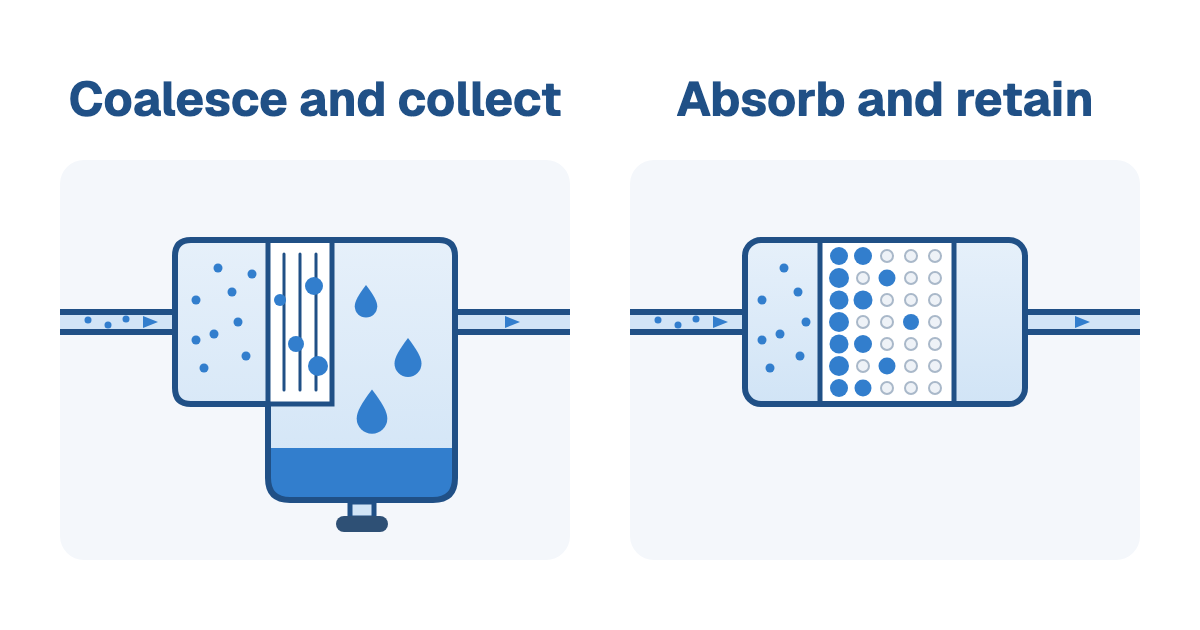
A coalescer brings small water droplets together so they can separate and collect for draining. An absorbent medium takes water into the material itself. Select between them by checking the fuel blend, the water present, operating flow and the documented performance of the proposed assembly. Neither name alone establishes the water concentration the complete system will achieve.
Follow the water through the filter
In a coalescing design, small droplets join to form larger drops. The assembly then separates those drops from the fuel and provides somewhere for the collected water to go. Filtertechnik's published explanation describes droplets collecting and draining at the bottom of the filter housing. The collection and drainage arrangement is part of the treatment system, not an incidental accessory.
Absorbing media take up water as fuel passes through them. That puts the retained water into a consumable element. Ask the supplier for the water-holding capacity, compatible fuels and replacement criteria for the exact cell being offered. A flow rating describes how fuel can move through an arrangement; it does not tell you how much water the element can retain before it needs attention.
The practical comparison is therefore a complete water-handling plan. For the coalescer, establish collection, drainage and the operating conditions required for separation. For the absorbent cell, establish capacity and how the site will know when replacement is required. The selection should account for who performs those tasks and how often they can realistically attend the equipment.
Check the fuel blend before choosing the mechanism
Fuel composition matters to separation. Filtertechnik's Filtasorb2 literature identifies lower interfacial tension in biodiesel-containing fuel as a challenge for traditional coalescing. Interfacial tension describes the behaviour of the boundary between the water and fuel. Changes at that boundary affect how droplets behave in a separation process.
That is a reason to examine the test evidence, not to reject every coalescer used with a biodiesel blend. Filtertechnik also documents coalescing designs intended for modern diesel and biodiesel applications. The useful question is whether the particular media and assembly have appropriate performance evidence for the intended fuel and duty.
Give the equipment supplier the fuel specification and declared blend, rather than only the word diesel. Ask which fuel the proposed performance result used and whether there are restrictions on blend, temperature or installation. A statement that a filter is compatible with a fuel category is not the same as a measured water-removal result under your operating conditions.
A removal percentage and a tank-cleanup result answer different questions
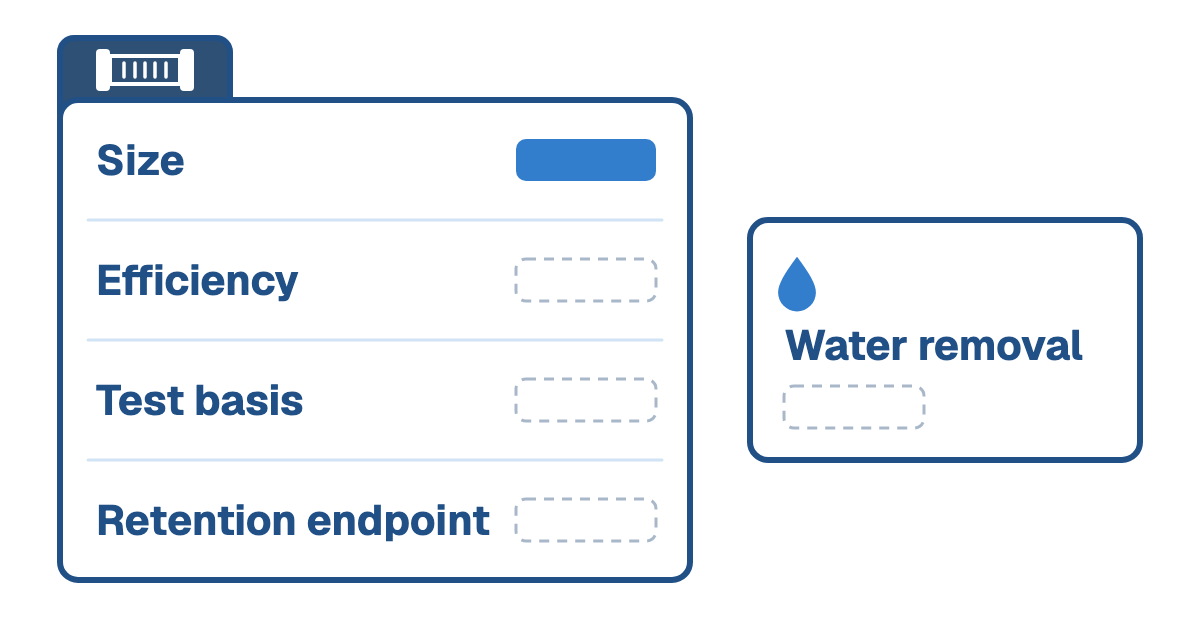
Two documented examples show why a headline comparison can mislead. Schroeder's HDP onboard-filter datasheet gives a suction-side coalescing result of greater than 95% single-pass water removal. Its table identifies a maximum flow of 158 gallons per hour and a test basis of Diesel Fuel Type A with 1,500 ppm water. It references ISO CD 16332, exactly as written in that sheet.
Filtertechnik's Filtasorb2 brochure reports a different kind of result: 700 litres of diesel reduced from 835 ppm water to 100 ppm in 30 minutes using one double-length filter cell. The brochure does not identify the diesel blend, temperature, operating flow or water-measurement method for that example. Treat it as the vendor's reported test result, not a promised cleanup time for another tank.
| Documented example | What the result describes | What the buyer still needs |
|---|---|---|
| HDP coalescing datasheet | Greater than 95% single-pass water removal; maximum flow 158 gal/h; Diesel Fuel Type A, 1,500 ppm water. | Evidence for the offered configuration, actual fuel and intended operating conditions. |
| Filtasorb2 brochure | A reported 700-litre diesel test, 835 to 100 ppm in 30 minutes, on one double-length cell. | The missing test details, the proposed water load and capacity, and how treatment will be verified. |
These examples cannot establish which technology is better by comparing 95% with 100 ppm. One reports a single-pass removal percentage under a stated test basis; the other describes a change in water concentration over time in a particular test. The starting water condition, test setup and reported measurement differ. Keep those distinctions when comparing supplier submissions.
The examples also do not make 100 ppm a universal acceptance limit or establish current availability of a specific configuration. Agree the required fuel condition against the applicable equipment and fuel requirements, then ask the supplier to demonstrate how the proposed system will be assessed against it.
Do not ask the particle rating to prove water removal
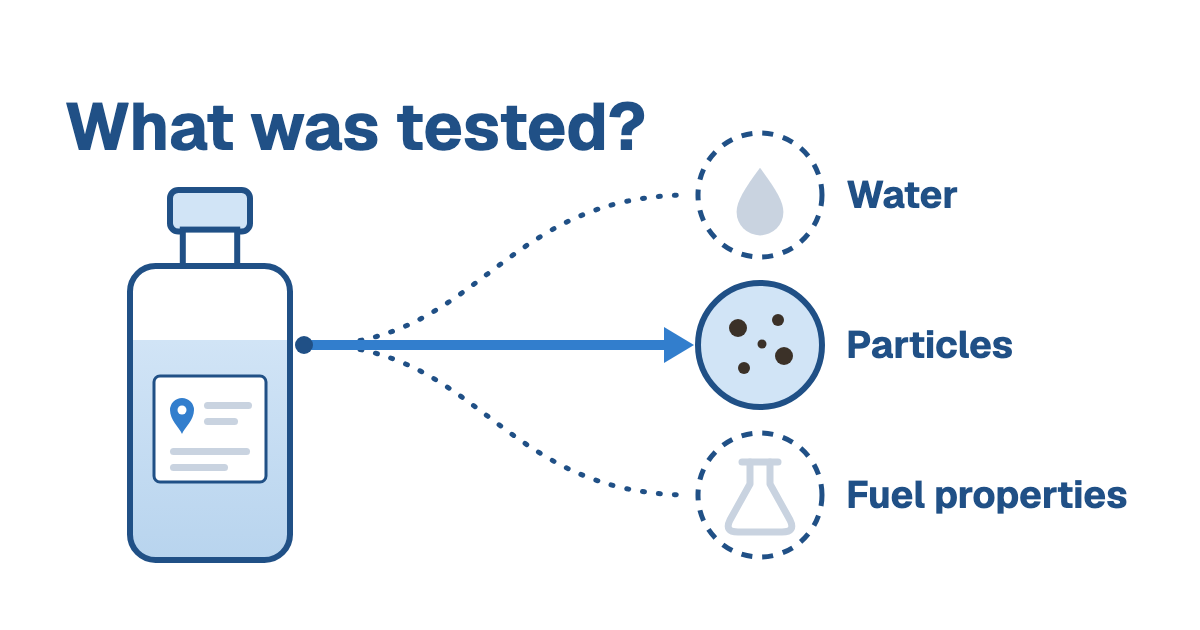
A filter may combine more than one function, but each needs its own evidence. A micron rating concerns particles. It does not establish the removal of water held within the fuel or dispersed as droplets. Check that the quotation identifies the water-removal medium, its supported water duty and the relevant performance conditions.
Likewise, a clear-looking sample does not settle the water-removal question. The measurement used before and after treatment needs to answer the same question at comparable sampling points. If the concern includes dissolved water, ask explicitly what the proposed process removes and how that will be measured. Do not infer dissolved-water removal from a photograph or a claim about free water.
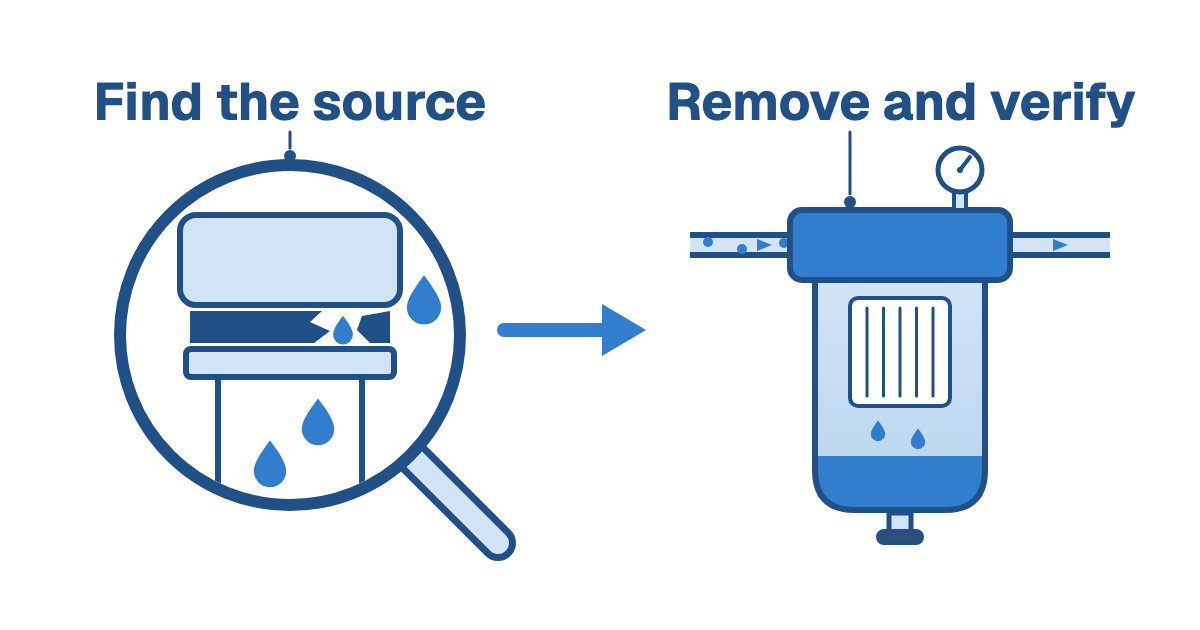
Our guide to water in diesel fuel explains the different water findings and the investigation of their source. This media-selection decision comes after establishing what the system needs to address.
Compare the service burden as well as the removal mechanism
Ask how the assembly deals with the expected water load between maintenance visits. A recurring water problem may require investigation upstream as well as treatment. Buying a different medium does not explain why water continues to enter or remain in the storage and transfer system.
For a coalescer, document the collection and drain arrangement, any water sensing, and the manufacturer's servicing instructions. For an absorbent element, document the supported retention capacity and change criteria. Avoid assuming that an automatic drain also changes elements, or that an absorbent cell can accept an unlimited amount of water.
Separate water handling from interruption of the fuel supply. If the equipment has to remain available during maintenance, the filtering paths and approved service procedure need their own review. That is a different question from whether coalescing or absorption suits the fuel.
See single and duplex diesel-filter arrangements for the maintenance-continuity decision. Neither arrangement by itself establishes the effectiveness of its water-removal media.
Specify the evidence you want before placing the order
A useful enquiry gives the supplier the fuel specification, available water results, required flow, installation location and maintenance constraints. Identify whether the duty is engine supply, transfer or tank recirculation. Then ask for a supported media recommendation, the operating limits of the selected assembly and a verification plan.
- Identify the fuel and water finding the recommendation addresses.
- Match the performance claim to a stated test fuel, flow and configuration.
- Separate water-removal performance from particulate filtration.
- Define how collected or retained water is managed during service.
- Agree comparable sampling, measurement and acceptance before treatment.
The decision is complete when the treatment mechanism, operating duty and verification method fit together. A brochure percentage can support that discussion. It cannot replace it.

Frequently asked questions
A coalescer brings water droplets together so the assembly can separate and collect them for draining. Absorbing media take up water into the material. Compare the fuel compatibility, operating limits, water handling and performance evidence of the complete proposed assembly.
Not as a general rule. Fuel composition can make separation more demanding, and manufacturers offer different media and designs. Ask for performance evidence and compatibility confirmation for the actual blend, flow and selected configuration rather than relying on a blanket claim about all coalescers.
The micron rating alone does not establish water-removal capability. An element may combine particle filtration with coalescing or absorption, but its water-removal duty and supporting test conditions must be identified separately.
No. The cited brochure reports 700 litres of diesel reduced from 835 to 100 ppm in 30 minutes on one double-length cell. It omits the blend, temperature, flow and measurement method for that example. Another application needs its own selection and verification basis.
A water-removal result addresses the measured water condition at the sampled location and time. Other fuel properties or contamination may need investigation. Define the assessment and acceptance scope for the intended fuel use before deciding that a batch can return to service.