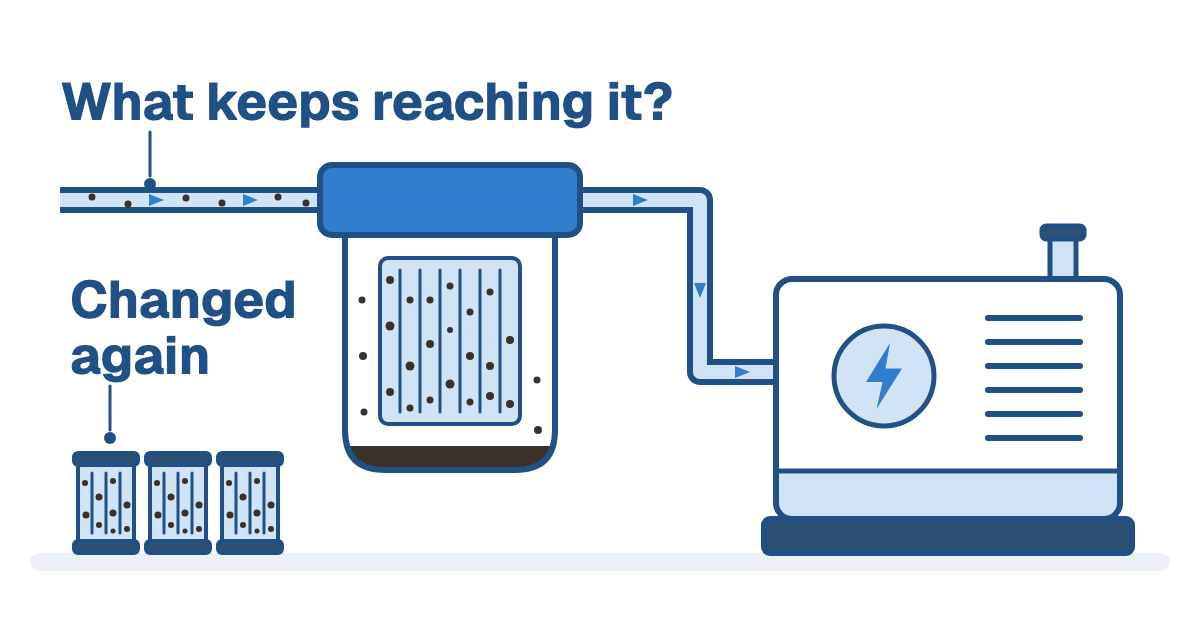
Water has appeared in the generator's separator again. The last drain is in the maintenance log, but nobody knows whether the water came with a delivery, entered the storage tank or remained there after the previous cleanup. Ordering another filter leaves that question unanswered.
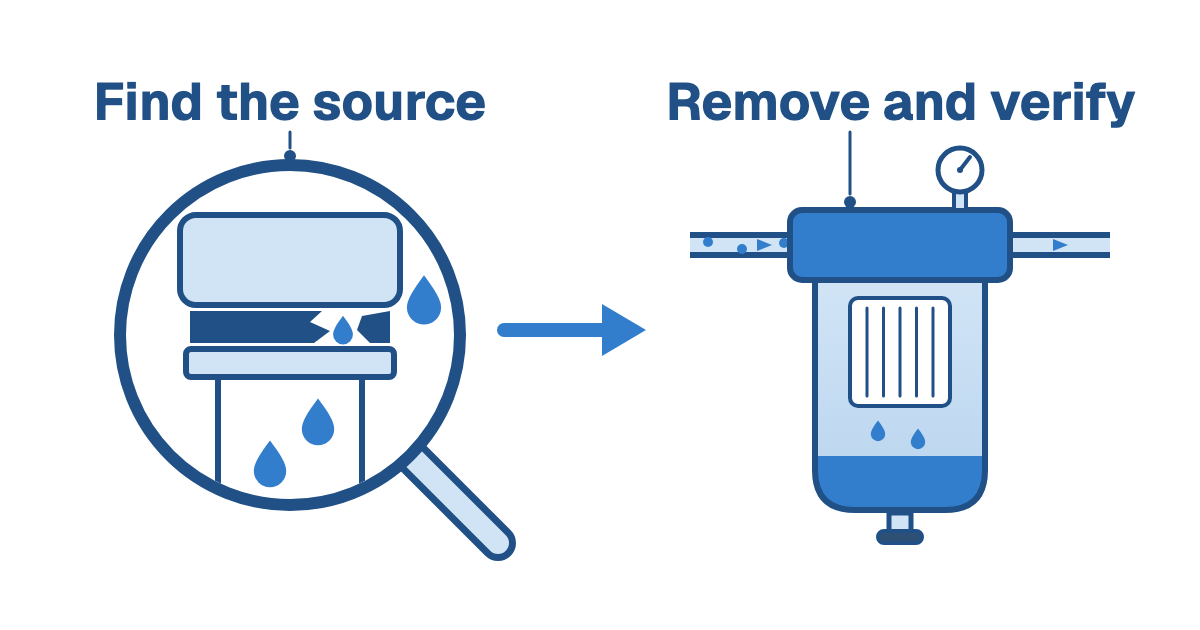
Water in diesel fuel needs a response that covers both the fuel and its source of contamination. Establish where the water is, investigate how it entered, select a suitable removal method and check the result. For a hospital, factory or construction site in Egypt, that means looking at the diesel supply path as well as the generator. A separator is one part of that path.
Find the route before blaming the delivery
Water can enter through damaged caps and seals or during storage and transfer. Condensation is another possible route when moist air meets cooler fuel or tank surfaces. Finding water after a refill does not, by itself, establish that the delivery caused it. Record the timing, then investigate the tank and handling equipment alongside the incoming fuel.
Start with the arrangement on site. Does the generator draw from a day tank that is filled from a separate bulk tank? Is the same transfer equipment used to fill several machines? Mark those points on a simple sketch. It gives the maintenance team and fuel specialist a common picture of what needs checking and prevents a clean result from one tank being applied to another.
Ask the responsible team to check fill points, seals and transfer equipment against their maintenance instructions. Keep water-drain records and recent delivery details together. If the source remains unresolved, successful water removal today may leave another job for the next maintenance visit.
Understand which form of water you are dealing with
Water does not always appear as a separate layer. Its form affects what you can see and which removal method can address it:
- Dissolved water is held within the fuel and is invisible. The amount the fuel can hold before water separates is its saturation limit, which depends on temperature and fuel composition.
- Free water has separated from the fuel. It can collect as droplets or settle at a tank's low points, where a sample taken higher up may miss it.
- Emulsified water is dispersed as small droplets that remain suspended in the fuel. It can be harder to separate than a collected water layer, so the treatment needs to suit the actual fuel.
Cooling can reduce the amount of water diesel holds dissolved. Water may then separate even though no new leak or delivery occurred. This is different from condensation adding water from the air. Both mechanisms can matter, but they answer different questions about why water has appeared.
That is why a clear bottle is weak evidence of water-free fuel. A drain check, a water-content test and an inspection of the fuel's appearance examine different parts of the problem. Record the fuel temperature where the measurement requires it and ask the specialist how the method handles the water present. Do not compare a tank-bottom sample with a circulating-fuel sample as though they came from the same material.
A clear sample does not close the investigation
Visible water and a laboratory water result are different pieces of evidence. A drain shows what collected at that point. A bottle sample describes the fuel taken from its recorded location. Neither observation establishes the condition of every part of a bulk tank, day tank and connecting pipework.
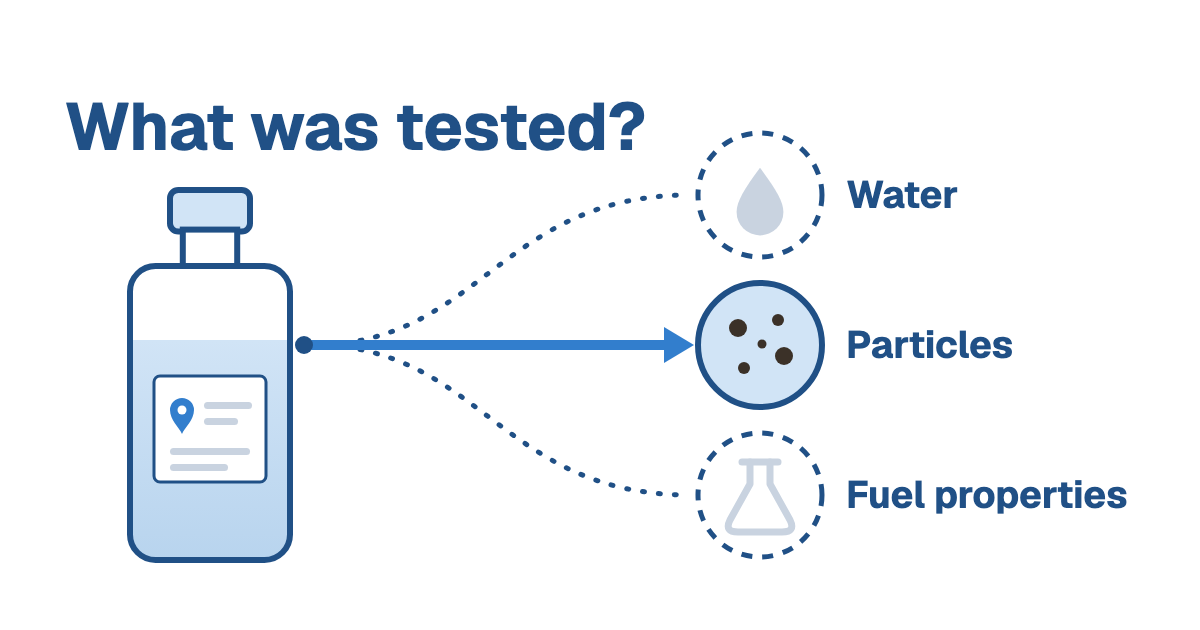
Agree sampling locations with the laboratory or fuel specialist. Identify the tank, sample point, date, recent deliveries and whether circulation or treatment was running. Keep the test method and units with each result. Our guide to choosing diesel fuel tests explains how to request evidence that matches the maintenance decision.
Free water can corrode tanks and fuel-system components. Corrosion debris can then add to the solids that filters must retain. Water at the fuel-water boundary can also support microbial growth. Suspected microbial contamination needs its own assessment; removing water does not establish that the microbial problem has been resolved. If generator fuel filters keep blocking, investigate the retained material rather than assuming water explains every blockage.
Specify what the water-removal system must do
A filter's particle rating does not tell you its water-removal capability. Ask the supplier to identify the water-removal stage and explain why it suits the fuel and conditions. Three questions help separate the scope:
- Where has water collected? The scope should explain how accumulated water will be reached and removed, including material outside the proposed circulation path.
- Is a coalescing stage suitable for the fuel grade, blend and intended flow?
- Is water-absorbent media appropriate for the measured water load and required outlet condition?
Coalescing is the joining of droplets, followed by their separation from the fuel. A micron rating describes particle filtration; it does not describe how water droplets will separate. Fuel blends can change how readily water droplets join, and operating flow affects the separation duty. Ask for suitability evidence for the fuel in your tank rather than relying on the housing's name or the pump rating.
Absorbent inserts retain water in their media. They have finite capacity, so a proposal needs to explain how the elements will be checked and replaced as water is removed. Neither a coalescing label nor a water-absorbent label establishes dissolved-water removal under every condition. Have the supplier state the required inlet condition, the expected outlet condition and how both will be measured. Our fuel filtration equipment guide connects these duties to the available system categories.
Filtertechnik, a NATCOM technology partner, documents water-absorbent Filtasorb2 inserts for fuel treatment. Its portable PDT-2 polishing system accepts selected inserts for water and particle duties. The practical point is to specify the media and verification method with the unit. The word "polishing" alone does not define what it will remove from your tank.
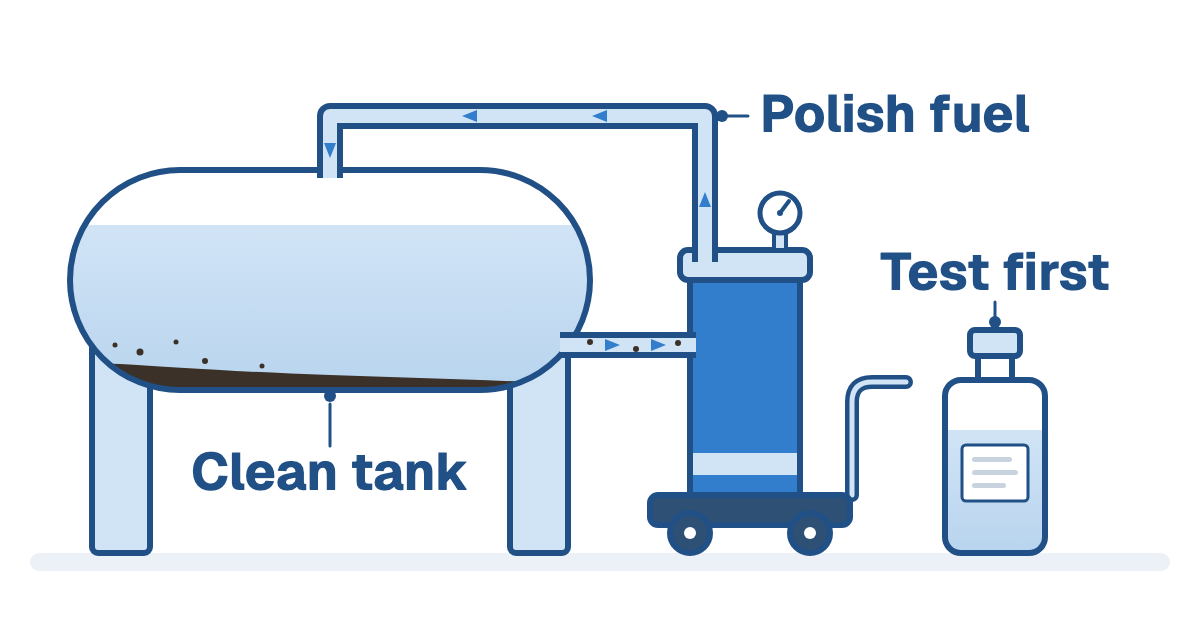
Tank condition belongs in the same scope. Water and residue that the circulation cannot adequately reach need an identified removal method. Our comparison of polishing, tank cleaning or replacement explains how those interventions can fit together. Agree the site's fuel-supply arrangements before work starts rather than assuming every tank can remain available throughout.
What a documented water-removal result looks like
Delta-Xero, another NATCOM technology partner, reports a UK data-centre project in which diesel was checked before planned transformer maintenance. The published laboratory tables record water falling from 3,831 ppm, or parts per million, to 18 ppm after six days of treatment with a mobile unit circulating fuel through a separate filtration loop. The site then proceeded with its planned maintenance and revised its generator-test procedures.
This is one documented treatment, not a six-day estimate or an 18 ppm target for another tank. Its useful lesson is the sequence: identify the condition before important generator duty, treat the fuel, compare measured results and change the maintenance practice. A photograph of clearer diesel would not have provided the same evidence. The full standby-generator fuel account explains the difference between a test start and evidence about the stored fuel.
Close the job with evidence and a named owner
Before treatment, agree the applicable fuel and equipment requirements, the sampling points and the tests used to judge completion. Include checks of the fuel supplied to the equipment, not only a sample immediately after the polishing unit. Use comparable follow-up results to assess whether the improvement holds. One passing sample is a snapshot.
Assign responsibility for separator checks, filter servicing, incoming deliveries and reviewing the next result. At sites where one contractor maintains the generator and another handles fuel, make the handover explicit. Both teams need the same tank identifiers and contamination history.
For a water-contamination review in Egypt, send NATCOM the tank arrangement, fuel grade, available results, water-drain history and recent delivery details. The diesel fuel polishing service can help define the assessment and treatment scope around those findings. The job is complete when the agreed evidence supports the result and the team knows how it will watch for water returning.
Adham Lotfy is NATCOM's Fuel Polishing Sales Engineer and a mechanical engineering graduate of the American University in Cairo. His background includes technical sales at Swagelok North Africa and industrial sales at Air Liquide.
Frequently asked questions
Possible routes include damaged fill-cap seals, contaminated transfer equipment and condensation as moist air meets cooler tank surfaces or fuel. Check the delivery and storage history alongside the tank condition. A water result alone does not identify the route or prove that the supplier delivered contaminated fuel.
A particle rating does not establish water-removal capability. The system needs a water-separation or absorption stage suited to the fuel and operating conditions. Check the actual element, its water duty, flow and maintenance requirements with the equipment supplier.
Draining according to the equipment instructions removes collected water from that separator. It does not show how much remains elsewhere or prevent further entry. Recurring water calls for investigation of the tank, fuel-transfer route and test history, followed by a defined removal and verification scope.
Recovery may be possible when suitable treatment can remove the contamination and the fuel remains appropriate for its intended use. Check the wider fuel condition as needed, select the water-removal method and agree acceptance criteria before treatment. Polishing is not a guarantee that any contaminated batch can be recovered.