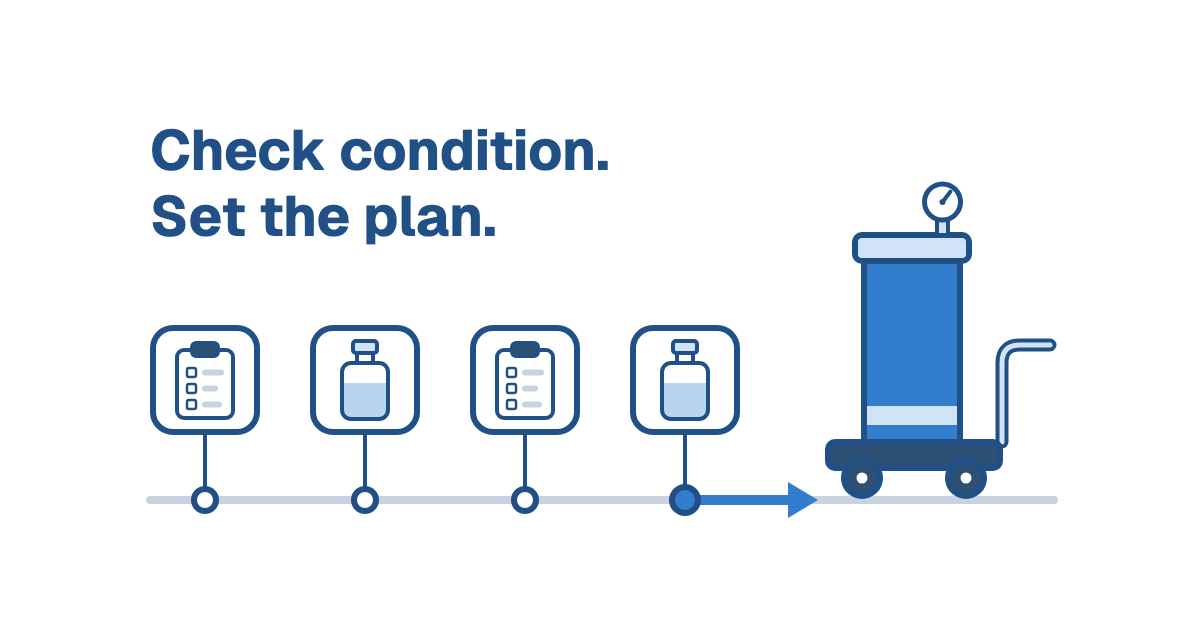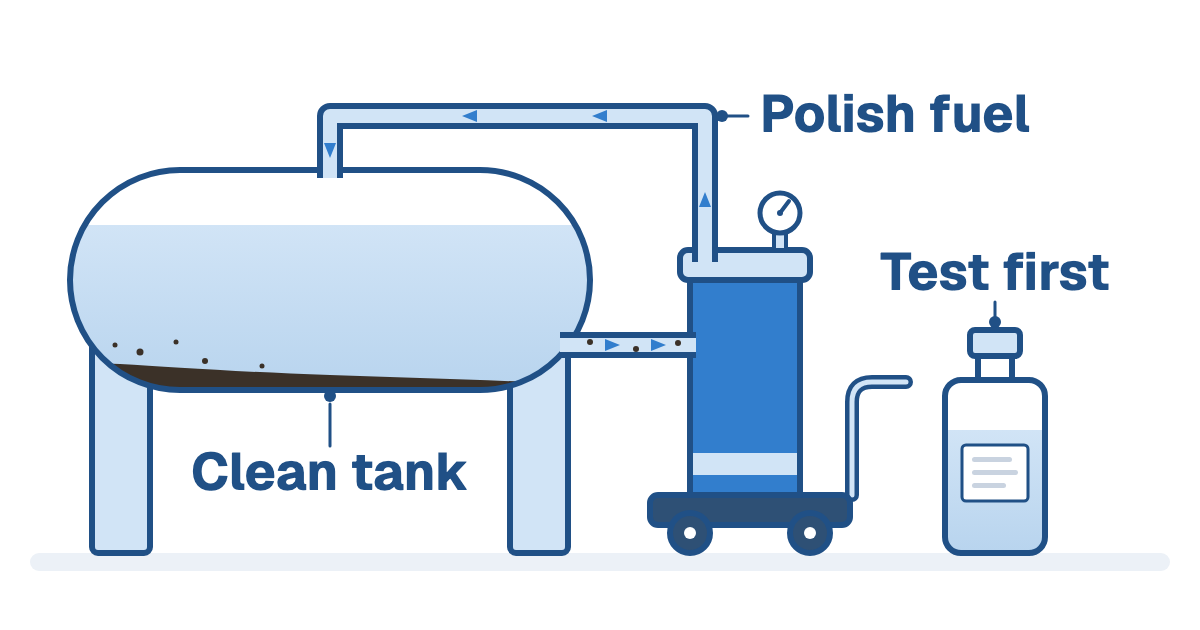
The polishing unit has completed its run and the contractor presents a clear fuel sample. The maintenance team now needs to accept the job. What evidence should the completion report contain?
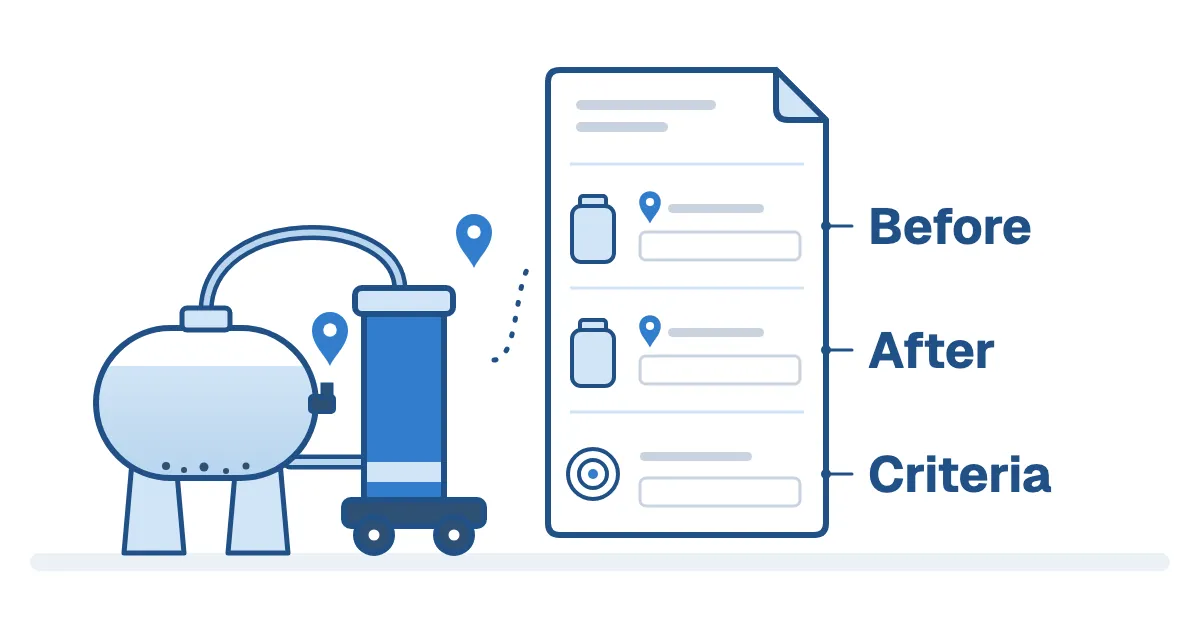
Ask the report to show the condition before and after treatment, where the samples came from, what was measured and how the results compare with criteria agreed for the fuel's intended duty. Treatment hours describe work performed. They do not, by themselves, establish the condition of the tank inventory or its suitability for use.
Define that evidence before mobilization. It is much harder to reconstruct an initial sample or resolve an ambiguous acceptance boundary after the hoses have been removed.
Decide what the job is meant to achieve
Write down the original problem. It might be elevated particulate, water in stored fuel, recurring filter blockage or an unresolved fuel-quality concern. Each calls for an explanation of which part the proposed treatment addresses and what additional investigation remains outside the job.
A particle-cleanliness result answers a particulate question. It does not establish every other fuel property. If the original concern includes chemical deterioration or suspected microbial contamination, agree the relevant tests and response separately. The diesel testing guide explains how to build the test scope around the concern.
Keep acceptance specific. A report should state the agreed criteria, their source and the intended application. Avoid a generic fuel passed statement that leaves the reader guessing whether it refers to particles, water, a wider laboratory panel or a complete operational-readiness assessment.
Identify what each sample represents
Suppose the final sample is taken immediately downstream of the polishing filter. It may be useful evidence about the treated outlet stream. The report should identify it that way. It should not silently become a claim about every part of the tank, connected pipework and downstream equipment.
Agree representative tank sampling with the responsible technical team, including any separate investigation of low points or suspected contamination pockets. Retain a drawing or clear location description with each sample. Distinguish bulk-fuel acceptance samples from diagnostic samples taken to investigate a particular concern.
Record tank identity, sample time, treatment status and any deliveries or transfers between samples. If fresh fuel entered between the initial and final test, the comparison needs that information. Otherwise a later reviewer cannot tell whether the change describes treatment of the same inventory.
Keep the treatment record beside the results
Ask for the equipment configuration, operating period, recorded flow where available, element changes, water removed where measured, and interruptions or access limits relevant to the work. These details explain how the job was carried out and where the evidence may be incomplete.
They also help distinguish a work record from an outcome. A stated number of circulation hours is not a particle measurement. A manufacturer's target cleanliness is not a result from your tank. Where a figure is calculated or estimated, the report should identify the assumptions rather than present it as a direct measurement.
Equipment manufacturing tests have another boundary. Filtertechnik describes factory leak checks and wet testing for its filtration systems. Those checks concern the equipment supplied. They do not replace the agreed before-and-after evidence for a particular fuel-treatment job.
What an actual vendor workflow documents
Filtertechnik's anonymous field-workflow account combines on-site particulate and relative-water-saturation testing with portable polishing, retesting and retained data for reporting. It supports specifying measurement as part of the job rather than treating it as an optional final photograph.
The source provides no account-specific initial or final results, treatment duration or acceptance criteria. Its quoted equipment capabilities cannot be borrowed as outcomes. NATCOM uses that distinction when discussing the scope of a diesel fuel polishing service.
The same discipline belongs in your completion report. Identify which statements are measured results, which are operating records and which describe the equipment's capability. A clear separation makes the report useful to the next maintenance planner and to anyone investigating a later recurrence.
Close remaining concerns explicitly
If the agreed tests are satisfactory but the tank has an unresolved water-entry route, record the corrective action and its owner. If sediment remains outside the treatment access, state the limitation and the next decision. The polishing and tank-cleaning comparison explains why those activities may need different scopes.
Plan a follow-up condition check around the system's history, turnover and duty. One satisfactory result records the sampled condition at that time. It cannot promise that future deliveries or continuing ingress will leave the fuel unchanged.
Before accepting the next quotation, request a sample report structure with empty fields for sample locations, methods, criteria, results and unresolved findings. That small step lets both parties agree what completion means while the work can still be specified properly.

Adham Lotfy is an Account Manager for Oil & Fuel Care at NATCOM and a mechanical engineering graduate of the American University in Cairo. His background includes technical sales at Swagelok North Africa and industrial sales at Air Liquide.
Frequently asked questions
Appearance alone does not demonstrate the agreed particulate, water or wider fuel-quality criteria. Use the relevant tests and representative samples defined in the work scope.
It describes the sampled outlet stream. Agree what additional representative tank evidence is needed before extending that conclusion to the stored inventory.
It establishes only the tested fuel condition and other findings within its scope. Generator readiness involves additional equipment and operational checks.
Ask the responsible technical parties to define suitable criteria and identify what the existing evidence can establish. Do not retrospectively claim that equipment targets were measured tank results.