The fan was quiet at one operating point, but its vibration is higher after the speed increased. Has a fault developed, or is the machine behaving differently because its operating conditions changed?
A higher overall reading cannot settle that question alone. Keep shaft speed and load with the vibration data, compare equivalent operating states and investigate which parts of the signal changed. Where speed varies during collection, choose an analysis method that can follow that variation.
This avoids two costly mistakes: ordering corrective work from an unmatched comparison, or dismissing a developing problem because the machine has always been described as variable speed. The operating change is evidence to examine, not a diagnosis.
Put speed beside every comparison
Record the actual measured speed where available, the drive arrangement and the process conditions relevant to the machine. A speed command and a measured shaft speed should be identified separately so the analyst knows what each record describes.
Suppose the previous reading was collected during a lower production rate and today's reading during a higher rate. Before calling the difference deterioration, ask whether comparable measurements exist at the same operating condition. Keep any remaining difference under investigation rather than treating the comparison as invalid and discarding it.
Also retain sensor location, direction, mounting and collection settings. The sensor-mounting guide explains how those changes can affect a trend. Operating context becomes useful only when the measurement arrangement is understood too.
Follow what moves with shaft rotation
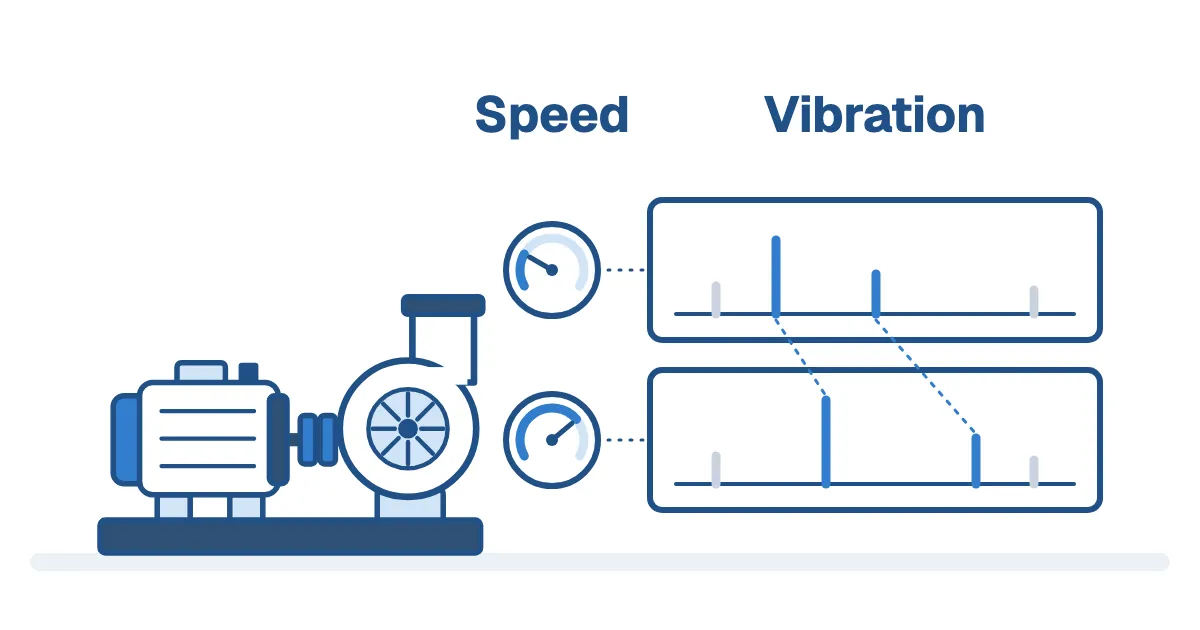
A frequency spectrum shows how vibration is distributed by frequency. A component associated with shaft rotation changes its frequency as shaft speed changes. For an illustrative calculation, 1,500 revolutions per minute is 25 revolutions per second; 1,800 is 30. A component repeating once per revolution would therefore move from 25 to 30 hertz.
That movement does not identify the cause of the vibration. It explains why comparing a fixed position on a frequency plot can miss the relationship to speed. Ask the analyst to show which components follow rotation and which other information is needed to interpret their behaviour.
An order expresses a component relative to shaft rotational frequency. One order, often written 1x, means once per revolution. Introducing that reference helps a team follow a component as speed changes without assuming that every rotating-frequency component represents the same fault.
When order tracking helps the measurement
TWave's T8 manual describes order tracking as processing that takes samples relative to shaft revolutions. It presents the spectrum in orders rather than ordinary frequency units. The manual explains that this is useful when rotational speed varies and shows how a conventional spectrum can spread a changing-speed component across several peaks.
Before specifying the feature, ask how speed will be measured, which shaft supplies the reference and whether the acquisition arrangement supports the intended analysis. Check the selected hardware and software options. TWave lists different configurations; a general product-family quotation does not establish that every required function is included.
Order tracking improves a particular way of viewing the signal. It does not provide an automatic mechanical diagnosis or make operating load irrelevant. The result still needs interpretation against the machine, signal quality and suspected mechanism.
A variable-speed monitoring account shows the application
TWave's published Endesa renewables account describes using its T8 Mobility Case for temporary diagnostic campaigns, including order tracking on variable-speed applications. The described work covers renewable machinery and special measurements, with qualitative diagnostic outcomes.
The account supports the use of a monitoring arrangement designed around changing duty. It gives no general detection rate, quantified saving or universal warning level that another site can borrow. Its value here is the choice of measurement capability for the machines being investigated.
TWave's case collection also includes a cement-process fan with load-dependent vibration. That is a reminder to retain process load with speed, rather than assume that a speed reference explains every change. Keep the two operating variables visible in the review.
Build an investigation across the operating range
Ask which operating states are needed to distinguish the suspected explanations. The analyst may need comparable steady conditions or properly captured changes between them. Agree the collection plan with the responsible site team within approved operating limits; do not vary production or cross a concern simply to complete a graph.
If vibration repeatedly increases in a particular region, retain that pattern and investigate its mechanism. The balancing, alignment and resonance guide explains why the repair choice needs evidence about the machine and supporting structure.
A repeatable pattern is useful information, but repeatability does not establish that the condition is acceptable. Conversely, a higher reading after a duty change does not automatically justify balancing or bearing replacement. Ask what finding supports the proposed work and what measurement would confirm its effect.
Preserve the operating context after corrective work
Agree the verification conditions before the intervention. A lower result at a different speed or load cannot, on its own, demonstrate that the original concern was resolved. Retain the relevant spectra, waveforms, speed information and machine history with the comparison.
The monitoring-method guide helps assess how measurements should be collected. For changing-speed machinery, add the question of how the chosen arrangement will preserve the operating information the diagnosis needs.
Start with the readings that triggered the concern and reconstruct their operating states. If those records are incomplete, define a better collection campaign. If a comparable change is confirmed, use it to guide the next diagnostic step. That gives the maintenance decision a stronger basis than either a single red number or the assumption that speed explains everything.

Frequently asked questions
No. Compare operating conditions and the signal components before diagnosing the cause. A speed-related pattern also does not prove that the condition is acceptable.
It expresses a vibration component relative to shaft rotational frequency. A 1x component repeats once per revolution; order analysis helps follow components as speed changes.
It can help analyze measurements while rotational speed varies. The speed reference, acquisition setup, selected software and signal quality must support the intended analysis.
A lower result at a different speed or load cannot establish the original concern is resolved by itself. Agree representative comparison conditions and the evidence needed before the work.