
The generator tank is almost full. The last delivery was months ago, and someone asks whether the diesel has expired. Buying another tankful is an expensive answer to a question that the delivery date cannot settle. Keeping it without checking is a weak answer too.
Diesel storage life depends on the fuel, the storage conditions and the requirements of the engine it will supply. For facilities in Egypt, the useful question is whether this batch remains suitable for its duty. Establish that through its history, tank inspection and appropriate testing. Age helps decide what to investigate; it does not replace the investigation.
Start with the delivery record, then look beyond it
Find the original delivery date, fuel grade and supplier documents. Add subsequent top-ups, transfers between tanks, treatments and periods when the tank was out of service. If old and new deliveries have mixed, the date of the latest invoice does not describe the whole contents.
Record consumption as well. A storage tank feeding working equipment has a different history from a hospital or data-centre reserve used mainly during generator exercises. The tank volume alone says little about how much of the fuel has been replaced. Explain the actual duty to the fuel supplier and the team reviewing the samples.
Consider an illustrative inventory: a tank holds 8,000 litres and receives another 2,000, with no withdrawal or loss. It now contains 10,000 litres, of which 80% came from the earlier stock. The delivery has added fuel; it has not removed the previous contents. Keep both delivery records. An average of their ages would be inventory arithmetic, not a test of whether the mixed fuel is suitable for the generator.
Supplier storage guidance should remain attached to the fuel grade and conditions it describes. A shelf-life statement from another product, climate or storage arrangement is not an acceptance limit for your tank. Where the records are incomplete, say so and agree an assessment that addresses that uncertainty.
Confirm which fuel is actually in the tank
Ask for the supplied specification and any declared biodiesel content. FAME biodiesel consists of fatty acid methyl esters. It is chemically different from paraffinic renewable diesel such as hydrotreated vegetable oil, or HVO. Those names do not describe interchangeable storage behaviour. Check the engine manufacturer's approval for the supplied grade and blend before applying a storage recommendation.
Where a site has changed suppliers or transferred fuel from another asset, obtain the relevant delivery documents and explain any mixing to the laboratory. A recommendation written for a particular biodiesel blend should not silently become the rule for every tank on site.
Two different problems can develop during storage
Contamination can enter through damaged caps, seals and transfer equipment. Water can accumulate, particles can collect, and water can support microbial growth. Fuel chemistry can also deteriorate during storage. Heat exposure, fuel composition and the storage environment affect that process. These problems need different evidence and may need different responses.
Oxidation is a reaction involving oxygen that can produce deposits as fuel ages. ASTM's storage stability guidance describes degradation that forms sediment and changes colour. Some contamination can therefore develop inside the stored fuel rather than arrive as dirt in a delivery. A darker sample alone does not identify the cause, but increasing sediment deserves investigation even when the tank has received no new fuel.
Water creates a separate concern. A settled water layer and the boundary where water meets diesel can support microbial growth. A clear sample collected above that layer may miss the condition at the bottom. Sludge or recurring restriction should lead to a suitable investigation, rather than an assumption that the fuel only needs another filter. The guide to repeated generator fuel-filter blockage explains how to separate possible causes.
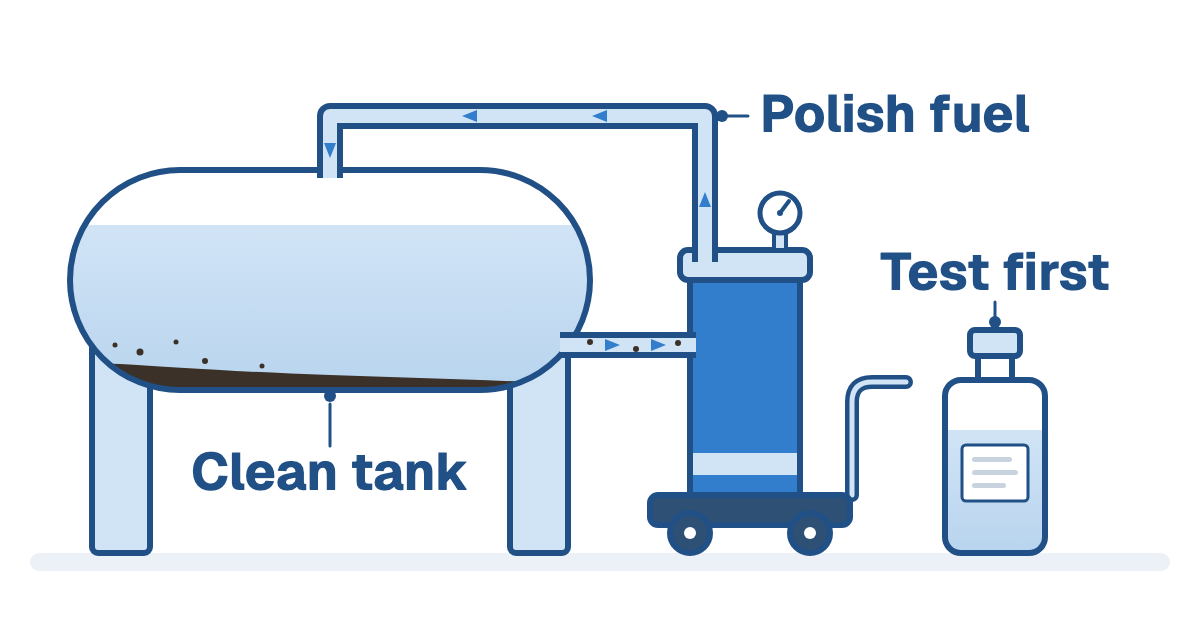
This distinction matters when somebody proposes polishing old diesel. A treatment loop selected for particles and water can address those contaminants. It cannot establish that the fuel has the correct grade or acceptable chemical properties. Clearer fuel is not evidence that every storage problem has been corrected.
For an outdoor tank at an Egyptian industrial site, record actual exposure and inspection findings. Check the filling and transfer arrangements, evidence of water ingress and how the fuel has been managed. Our guide to water in diesel fuel explains why removing water and finding its entry route belong in the same assessment.
Tell the laboratory which decision the tests need to support
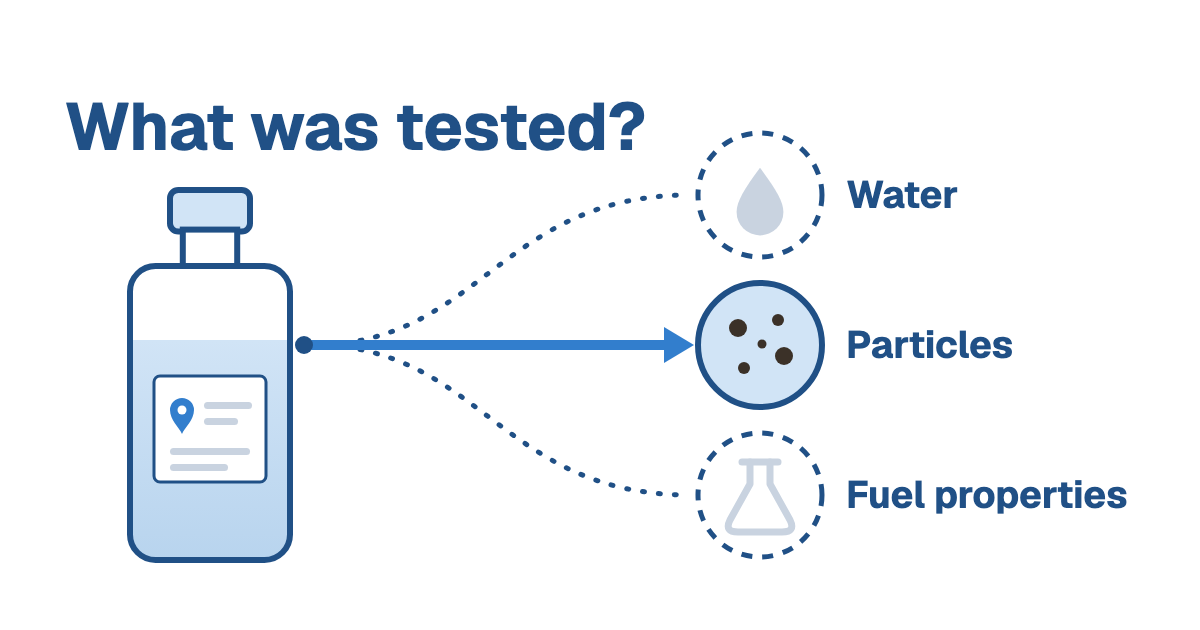
Tell the laboratory and fuel specialist that the decision is whether to retain a stored batch for a particular engine. Provide the fuel identity, storage history, symptoms and applicable supplier and equipment requirements. They can then define which contamination and fuel-quality properties need checking. A particle count alone is too narrow to answer every question about aged diesel.
- Water and particles: establish the contamination present in the submitted sample and whether the selected treatment has addressed it.
- Fuel stability: ask whether an oxidation-stability test is relevant to the storage history and suitable for the actual fuel composition.
- Other fuel properties: agree whether acidity, measured as acid number, or other properties need checking against the applicable fuel and engine requirements.
An accelerated stability result is not a countdown to expiry. For example, ASTM D2274 assesses fuel under defined test conditions; its published scope says it cannot precisely predict the insoluble material that will form during a particular period of field storage. It is also not validated for biodiesel or biodiesel blends. Ask the laboratory to choose and explain an appropriate method instead of requesting a test by name and assuming it covers every fuel.
Agree sampling locations before collecting anything. A sample from the fuel supply and one investigating material at a tank low point answer different questions. Label the tank, date, location, recent delivery and any treatment. Keep the sample plan consistent enough that later results can be compared. The diesel fuel testing guide explains how to match the test scope to the decision.
What a stored-fuel recovery case actually establishes
A documented UK data-centre project from Delta-Xero, a NATCOM technology partner, shows why condition deserves attention before a replacement decision. The site planned transformer work that would depend on its standby generators. Fuel testing identified contamination, and the work was postponed while the diesel was treated.
The published laboratory tables recorded water falling from 3,831 to 18 parts per million, or ppm, after six days of circulating the fuel through a separate filtration loop. Particle cleanliness was measured separately and also improved. Those results supported recovery of that site's contaminated fuel. The report does not establish the fuel's age or promise another period of storage life after treatment.
The distinction is practical. Recovery can be worth assessing, but a cleanup result cannot become a new expiry label. See the standby-generator fuel case for the fuller evidence and operating context.
Make the retain, treat or replace decision explicit
The site team needs a written recommendation that connects the findings to the intended duty. Where the evidence supports retaining the fuel, record the conditions and next review. Where removable contamination is the problem, define treatment and verification. Where the fuel is unsuitable beyond what treatment can correct, involve the supplier in the replacement decision.
- Retain: identify the results and requirements supporting continued use, the duty assessed, and the monitoring or storage conditions attached to that recommendation.
- Treat and reassess: name the removable contaminant, the proposed removal method, and the comparable samples and tests needed to judge the outcome. A better particle count does not resolve an outstanding stability question.
- Replace: explain which requirement the fuel cannot meet and why the available treatment is insufficient. Plan the tank work needed before a replacement delivery.
- Evidence incomplete: identify the missing document, sample or test. An unresolved report should not be described as approval for the planned duty.
Include the tank in the plan. A fresh delivery does not remove residue already inside or repair water ingress. Our comparison of polishing, tank cleaning and replacement sets out what each action addresses. Do not let the purchase order for new fuel close an unresolved tank problem.
Keep a review date alongside the fuel record
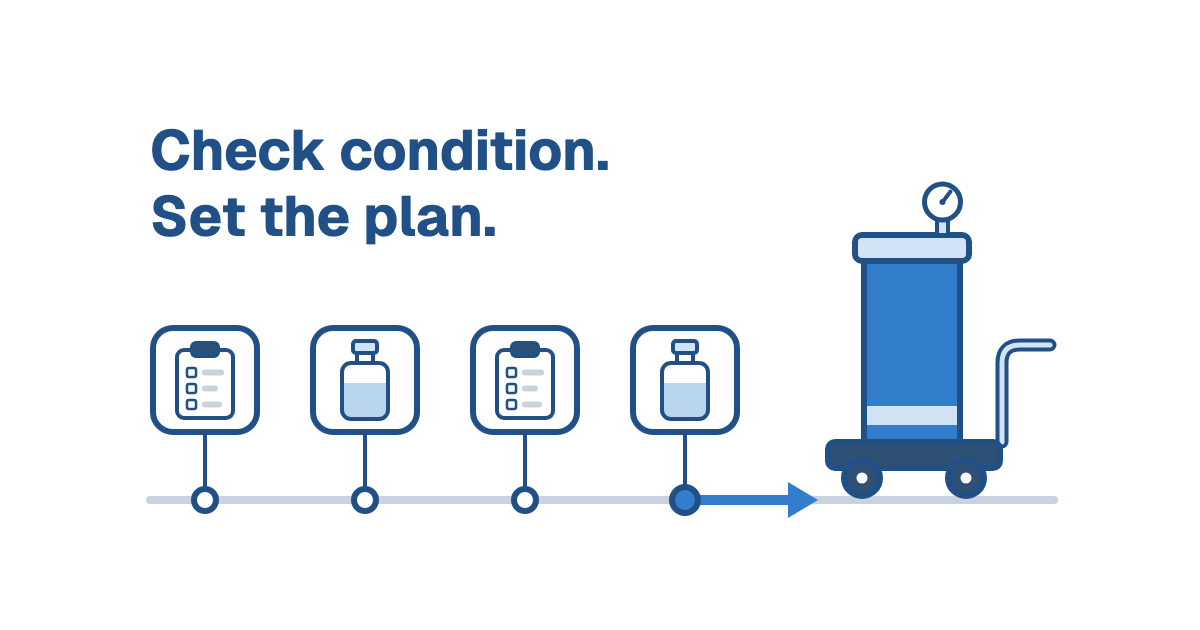
After the assessment, retain the results, sampling details, supplier advice and agreed action. Set a review date and identify events that require an earlier check, such as a suspect delivery, water ingress or recurring filter restriction. Review comparable follow-up results before concluding that the condition is stable. One passing sample describes one sample at one time.
Keep tracking actual consumption after the review. Frequent generator exercises do not necessarily mean the reserve has turned over if each run consumes only a small part of it. Keep delivery and consumption records together, and carry out the tank inspections required by the equipment and supplier guidance. Use the findings to set the next assessment, as explained in our guide to fuel polishing frequency.
For a stored-diesel review in Egypt, send NATCOM the tank arrangement, delivery history, fuel documents and available reports through the diesel fuel polishing service. The first decision is what the evidence supports doing with the fuel already there.
Adham Lotfy is NATCOM's Fuel Polishing Sales Engineer and a mechanical engineering graduate of the American University in Cairo. His background includes technical sales at Swagelok North Africa and industrial sales at Air Liquide.
Frequently asked questions
There is no storage period that clears every tank for use. Fuel grade, supplier guidance, heat exposure, water, tank condition and turnover all matter. Record the delivery history and assess the fuel against the requirements of the equipment it will supply. A calendar date alone cannot confirm its condition.
No. Polishing can remove particles and water with suitable treatment equipment, but it does not give the fuel a new manufacture date or establish that chemical deterioration has been reversed. Agree the relevant fuel-quality tests and follow-up before deciding whether to retain it.
Do not use a top-up as a substitute for assessing suspect fuel. Establish the existing fuel's identity and condition, the incoming grade, compatibility and tank condition with the supplier. Adding fuel does not remove settled residue or repair a route for water to enter.
Yes. Appearance alone cannot establish water concentration, particle cleanliness or all the chemical properties needed for the intended duty. Select the tests from the storage history, symptoms and fuel specification, then compare results from documented sampling points.